About Saltator similis d'Orbigny & Lafresnaye, 1837
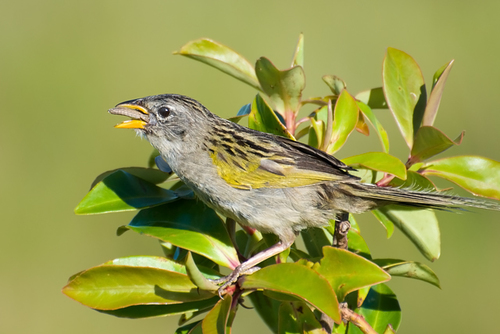
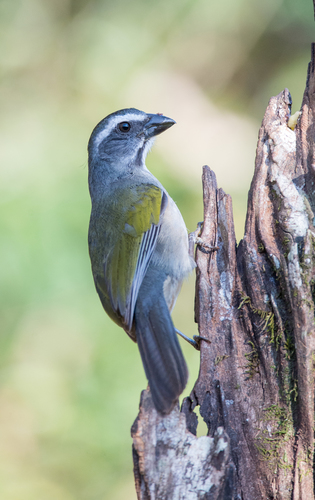
This species is slightly smaller than other species in its genus, but shares the same strong black beak that gives the group its common name. Like Saltator maximus, it has a green back, gray tail, and gray sides of the head. Among the three compared species, adult birds have the longest superciliary stripe; their "mustache" stripe is less defined, and their throat is entirely white. On the underparts, gray dominates the sides, turning orange-brown and white in the center of the belly. The wings are greenish. Juveniles do not have such a long superciliary stripe; the stripe can be faint or non-existent right after juveniles leave the nest. Some juveniles have striped underparts. Its beak is very strong and sturdy, which gave the local common name "iron crack", and its tail has a distinct size. There are no visible physical differences between males and females. Its song varies slightly between regions, while still retaining the same timbre. It inhabits forest edges and clearings, and is always associated with forests, occupying the middle and upper forest strata. Its distribution includes central and northeastern Brazil, the southern Brazilian state of Bahia, Rio Grande do Sul, the entire Southeast region of Brazil, and extends across neighboring international borders into Argentina, Bolivia, Paraguay, and Uruguay.