About Saltator olivascens Cabanis, 1849
Scientific name: Saltator olivascens Cabanis, 1849
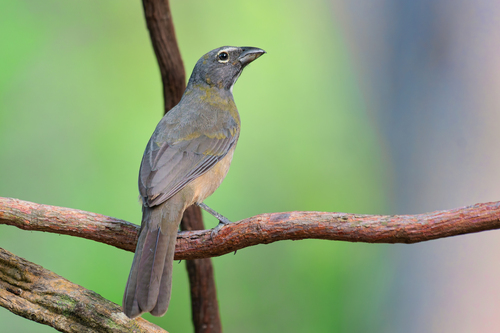
Description: The olive-grey saltator has a thick, black bill that is slightly hooked at the end. It has white supercilliaries that create a distinct white eyebrow marking, plus a thin white crescent below its eye. Distinct black malar stripes frame both sides of its white throat. Its underside is light grey, with some buffy coloring on the flanks and undertail coverts. Despite its common name, this bird is only slightly olive-colored; it has a primarily dark grey back. This feature distinguishes it from the closely related, similar-looking buff-throated saltator (Saltator maximus) and streaked saltator (Saltator striatipectus), both of which have clearly olive, not grey, backs. Adult males and females look similar. Juveniles have an olive and yellow wash instead of grey, especially on their undersides.
Distribution: This species occurs across most of northern South America, ranging from northeastern Colombia through Venezuela and the Guianas into extreme northern Brazil, and is also found in Trinidad. Each of its subspecies occupies a separate range within this overall distribution. The nominate subspecies S. o. olivascens is found from the Tepuis of southern Venezuela to the Guianas, Suriname, and adjacent northern Brazil. S. o. plumbeus occurs along the Caribbean coast of northern Colombia, from the Río Sinú to the Magdalena Valley. S. o. brewsteri ranges from tropical northeast Colombia to Venezuela, and also lives on the island of Trinidad. The olive-grey saltator is a non-migratory resident species.
Habitat: Olive-grey saltators are commonly found in a range of edge habitats, including forest edges, shrublands, inland wetlands, and second growth forests. They thrive well in human-modified habitats such as orchards, gardens, cleared areas, and areas near human homes. They have even been observed in parks and botanical gardens in an urban metropolitan area of northern Colombia, showing they can successfully live in certain types of anthropogenic environments.
Reproduction: Individuals reach breeding age at 1 year old, have an average lifespan of about 3.8 years, and a recorded maximum age of 9 years. Olive-grey saltators nest in dense vegetation. They build a bulky open-cup nest from dead plant material, and sometimes incorporate man-made materials like paper. The nest is lined with finer materials such as grasses and thin stems. Little detailed information is available about this species' nesting habits. The birds are known to lay clutches of 2 to 3 eggs; the eggs are light blue or turquoise, marked with black scrawls, and have a smooth shell and oval shape.