About Saltator coerulescens Vieillot, 1817
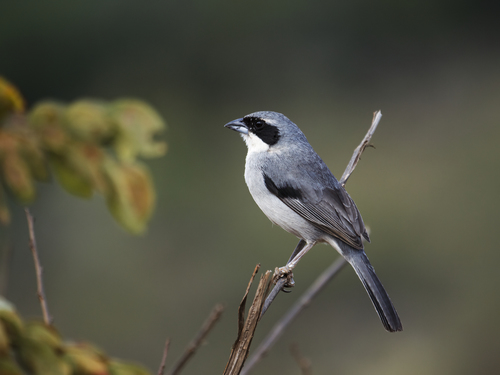
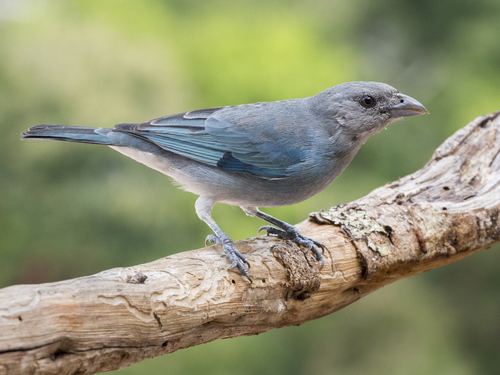
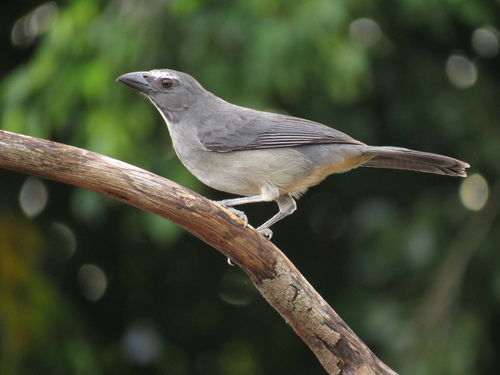
The bluish-grey saltator, Saltator coerulescens Vieillot, 1817, averages 20 cm in length and 52 g in weight. Its plumage varies with age and subspecies, but generally the bird has grey or greyish-olive upperparts, a white stripe over the eye, a narrow white throat, a grey breast, and a buff or cinnamon belly. Its common call is a long-drawn upward slur, rendered ch'wheeet or ch'kweeee, sometimes with a more elaborate opening, such as hi'whee chu weeeeh. Its song is a usually fairly short warble, which can range from nasal to mellow in tone. This species is found across a wide variety of semi-open habitats, including woodlands, scrub, and forest edges, and avoids the interior of dense forests. It occurs in tropical and subtropical South America, with a range that includes northern Argentina, western Uruguay, Paraguay, widespread areas of Brazil (where it is replaced by the olive-grey saltator in the extreme north near the borders with the Guianas and Venezuela), Bolivia, eastern Peru, eastern Ecuador, and southeastern Colombia (where it is replaced by the olive-grey saltator in central and northern parts of the country). The bluish-grey saltator feeds on fruits, buds, and slow-moving arthropods. It forages at low and middle vegetation levels, and sometimes occurs in pairs or small groups. It may also join mixed-species flocks that can include other saltators. Each clutch holds two pale blue subelliptic eggs, which measure approximately 23–31.5 mm long by about 17–22 mm wide and weigh about 5 grams each. These eggs are unusual for the genus Saltator because they have a circle of blackish-brown fine lines and dots around the blunt end. Eggs are laid in a bulky cup nest built 2–4 m high in a tree.