About Salsola soda Weinm., 1822
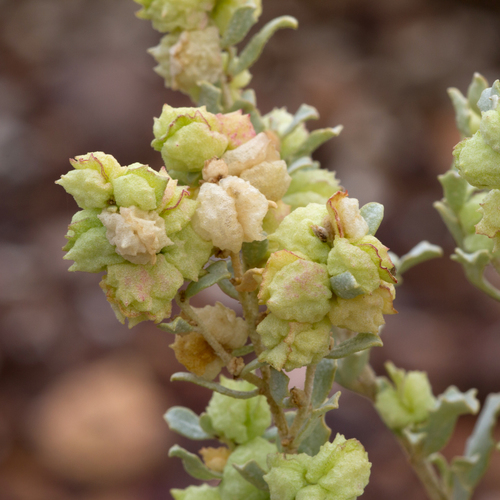
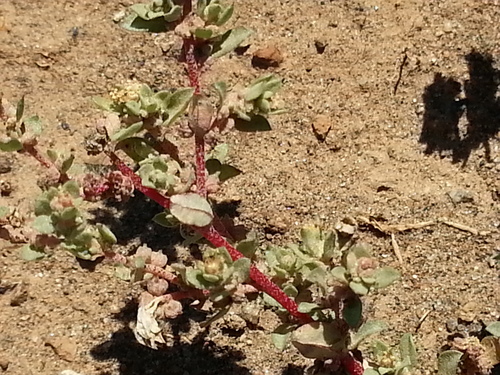
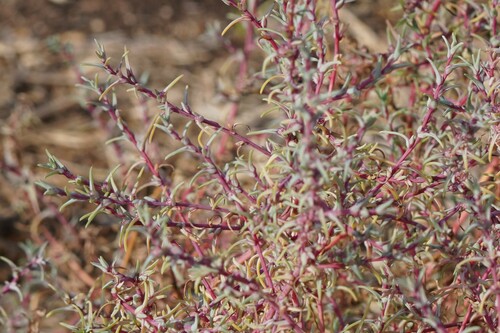
Salsola soda Weinm., 1822 is an annual succulent subshrub that grows as a small shrub up to 0.7 meters tall. It has fleshy green leaves, and its stems can be either green or red. Tiny flowers develop from inflorescences that emerge from the base of the leaves near the stem. Salsola soda is native to Eurasia and North Africa, and was historically well known in Italy, Sicily, and Spain. In modern Europe, it also grows on the Atlantic coasts of France and Portugal, and on the Black Sea coast. It has become naturalized along the Pacific coast of North America, where there is concern about its invasiveness in California's salt marshes. It is also reported to be naturalized in South America. In English, the Italian name agretti is commonly used to refer to the edible leaves of S. soda; barba di frate (meaning friar's beard) is the most common name for the plant in Italian. This plant is not a summer green, and should be started early indoors or in autumn. Its seeds are well known for poor germination, with a standard germination rate of around 30 to 40 percent, similar to rosemary. Though it is often grown in land irrigated with salt water in the Mediterranean Basin, it can also grow without salt water. S. soda is harvested in bunches when it is small, or cut regularly to encourage new growth when mature. It is most commonly boiled and eaten as a leafy vegetable; the standard recommendation is to cook it in boiling water until the leaves soften, and serve it while it still retains some bite (crunch), similar to samphire. It can also be eaten raw, and is described as tasting grassy and slightly salty, with a pleasant crunchy texture. Salsola soda is sometimes confused with okahijiki (land seaweed), a plant known in Japan that is actually the species Salsola komarovii. The harvested leaves of the two species have a similar appearance.