About Salix scouleriana Barratt
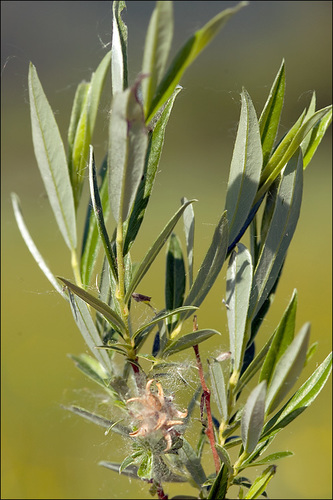
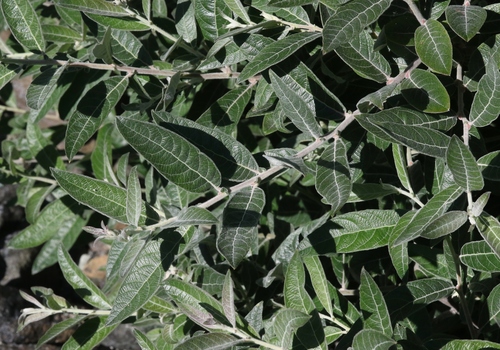
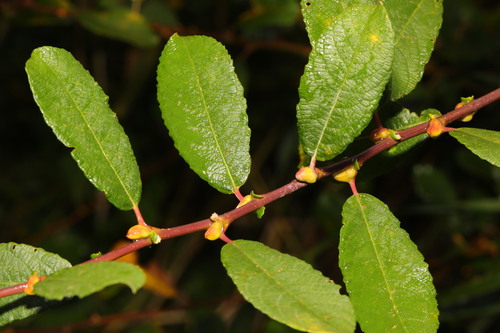
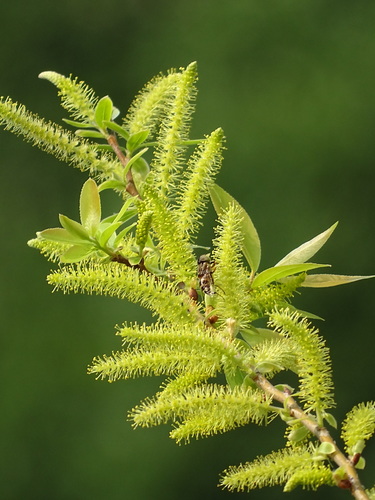
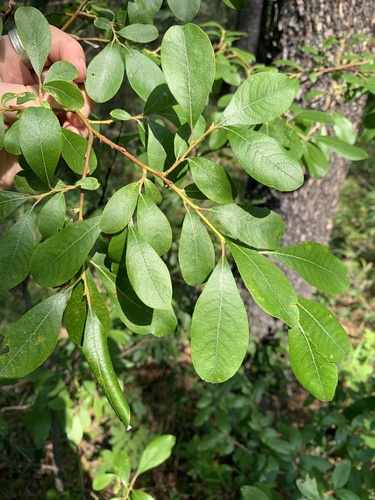
Salix scouleriana Barratt is a deciduous plant that grows as either a shrub or a small tree, depending on its growing environment. In harsh conditions like dry, cold sites at high elevation, it usually produces multiple stems that reach 2 to 7 metres (6+1⁄2 to 23 ft) tall. In favorable growing sites, stems reach 10 to 20 m (33 to 66 ft) or more in height. The stems are typically straight and bear few branches, which usually forms narrow crowns. Its root system is fibrous, deep, and widespread. The thick sapwood is nearly white, while the heartwood is light brown with a red tinge. The bark on stems is thin, gray or dark brown, marked by broad, flat ridges. Twigs are stout and whitish-green. The leaves are oblanceolate to elliptic, 5–12.5 centimetres (2–5 in) long; most are short-pointed at the apex, tapered toward the base, and have margins that range from entire to sparsely wavy-toothed. The upper leaf surface is dark-green and nearly hairless, while the lower surface is covered with white or grayish hairs. This species is dioecious, meaning male and female flowers grow on separate individual plants. The tiny flowers are grouped into catkins similar to those of pussy willow. Each flower has two anthers, which are yellow and sometimes red-tipped; pistils are red. The fruit is a light reddish-brown, long-pointed capsule around 0.75 cm long. When the fruit matures, it opens to release a white fluffy material that holds tiny embedded seeds. The species has a chromosome count of 2n = 76 or 114. It flowers from mid to late spring, with flowers appearing before leaves, often while snow is still on the ground. Fruiting occurs from late spring to midsummer, depending on the region. Flowers of this species are pollinated by insects. There are approximately 14,300 cleaned seeds per gram. Germination is epigeal, and begins within 12 to 24 hours after seeds land on wet ground; germination usually reaches 95% within one to two days. Seeds are dispersed by wind. If cut or top-killed, plants resprout from the root collar. Pieces of stem and root will root and grow if partially buried in moist soil. This species is native to western North America. Its range extends from south central Alaska east to western Northwest Territory, central Manitoba, and the Black Hills of South Dakota, and south through the Rocky Mountains to Coahuila. It also grows along the coast through British Columbia, Washington, Oregon, and the Sierra Nevada in California. In the Rocky Mountains, it grows from sea level up to an altitude of 2,100 m (6,900 ft); across its entire range, it can be found from near sea level up to around 3,000 m (9,800 ft) in elevation. Scouler's willow is the most common upland willow across most of its range. It quickly and abundantly invades areas after fires and logging activity. Seedling establishment requires a mineral soil seedbed (Forest Practices Branch 1997). In northern areas, it grows in muskegs, willow thickets, disturbed areas, and forests. At lower latitudes, it grows in former clearcuts, burned areas, thinned forests, and naturally disturbed sites such as avalanche paths and river flood zones. All these sites are moist, with drainage ranging from well-drained to poorly drained. Although Scouler's willow tolerates drier conditions than most other willows, it cannot survive in xeric conditions. It occurs as a component of a wide range of vegetation types throughout its range. With very few exceptions, it is the only willow species that grows alongside other trees in upland Western forests. It colonizes soils of all textures, including skeletal soils and soils formed from most parent materials. All but low-severity fires top-kill this species, but usually more than 65% of affected plants sprout quickly after fire. It is intolerant of shade, and begins to decline when overtopped by conifers and other trees. Male Scouler's willow flowers provide pollen for bees in the spring. It is an important larval host to the blinded sphinx, Lorquin's admiral, modest sphinx, mourning cloak, twin-spotted sphinx, and white admiral. In inland mountain areas, big game feed on this species. Scouler's willow protects soil and helps sites return to forest cover following disturbances. When growing along streams, it protects stream banks from erosion and shades the watercourse, helping to maintain cooler water temperatures. The cover it provides is important for a variety of mammals and birds. Its flowers supply pollen and nectar to honey bees in early spring. It is an important browse species for domestic livestock and wild animals. Cattle, sheep, and goats all use it for browse. It is sometimes the most preferred food source for white-tailed deer, black-tailed deer, mule deer, elk, moose, and bighorn sheep. Small mammals, bears, upland game birds, and waterfowl feed on its leaves, buds, and seeds to a lesser extent. Fresh browse made of its twigs and leaves contains 41% dry matter, 4% protein, 2% fat, 20.8% nitrogen-free extract, 11.2% crude fiber, and good quantities of mineral nutrients. The wood of Scouler's willow is soft and close-grained. It is not sawn into lumber, but is used to a limited extent for firewood and wood carving. The Secwepemc people of British Columbia used the wood for smoking fish, drying meat, and constructing fishing weirs. They used the inner bark for lashing, sewing, cordage, and headbands, and prepared decoctions of twigs to treat pimples, body odor, and diaper rash. Some Indigenous tribes used the stems as frames for buildings.