About Salix richardsonii Hook.
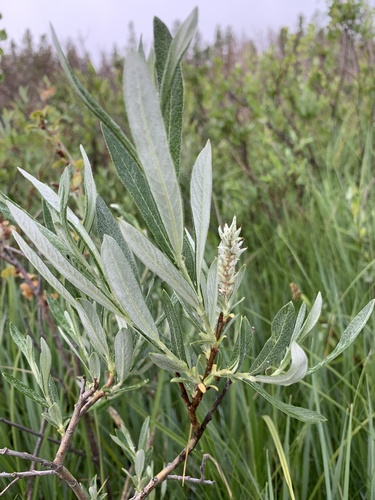
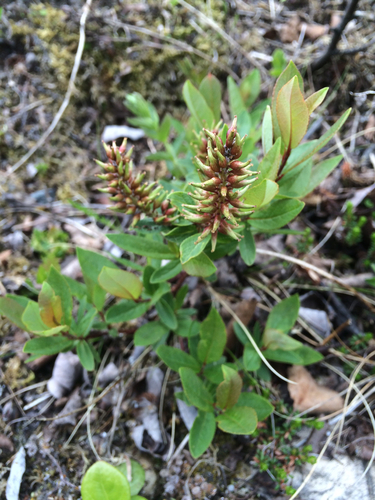
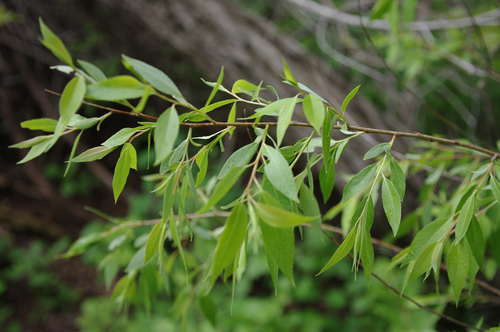
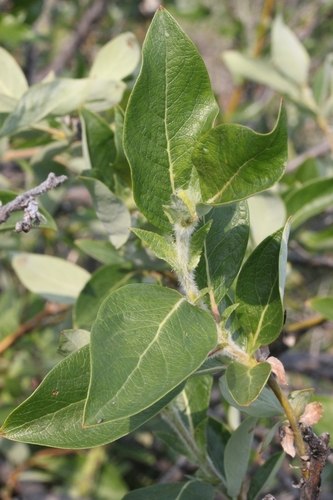
Salix richardsonii is a flowering plant species in the willow family, Salicaceae. Its common names are Richardson's willow and woolly willow. It is native to Russia and northern North America, specifically occurring in Alaska and northern Canada. Some taxonomic authorities do not recognize it as a separate species, instead classifying it as the subspecies Salix lanata subsp. richardsonii (Hook.) A. K. Skvortsov. This willow is a branching shrub that forms dense thickets. Most individuals grow 1 to 2 meters (3.3 to 6.6 feet) tall, though the species can reach up to 6.5 meters (21 feet) in height. Alongside Salix pulchra and Salix alaxensis, it is the tallest willow species found in the Arctic Archipelago. The stems of this species have smooth, hairless bark, while young twigs are covered in thick hair. The wood of this willow becomes brittle as it ages. This is a dioecious species, meaning male and female reproductive structures grow on separate individual plants. Its inflorescence is a catkin, which emerges before the leaves in spring. Flowers of Salix richardsonii are most commonly pollinated by bees. Seeds of this species are only viable for a short period, and germinate immediately when they come into contact with moist substrate. Salix richardsonii can form natural hybrids with other willow species, including Salix barclayi and Salix calcicola; the hybrid Salix calcicola × S. richardsonii has been recorded growing on Southampton Island. This common willow grows along streams and in other moist habitats in the Arctic and above the timberline. It can also be found in spruce forests, woodlands, and areas that have recently burned. It grows on floodplains and other habitats that experience periodic flooding, as well as on pingos and open tundra. This species helps stabilize eroding streambanks, and readily colonizes disturbed areas and bare sites cleared of debris. It is fire-tolerant, and resprouts easily even after most of its aboveground growth has been burned. The plant provides food for many animals, including moose, caribou, and beavers. Its dense thickets provide wildlife cover, and beavers use the branches to construct their dams. Thickets growing along streambanks allow water to undercut the bank, creating overhangs that serve as hiding spots for fish. Native Americans used parts of this willow species, alongside other willows, for medicinal uses, basket weaving, crafting weapons like bows and arrows, and building animal traps. The bark was boiled to make a broth used to treat sore throats and tuberculosis, a use linked to the presence of salicylic acid.