About Salix repens L.
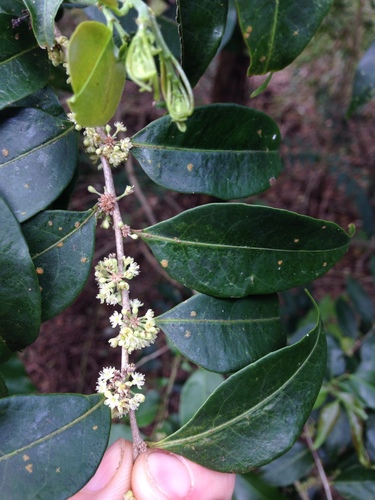
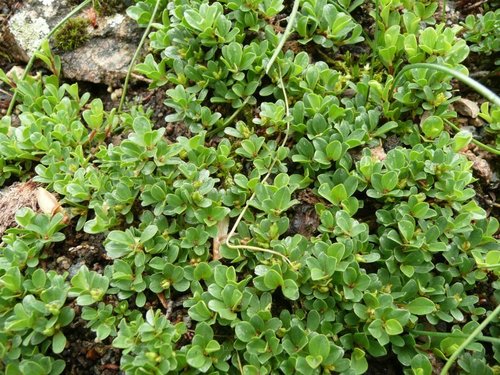
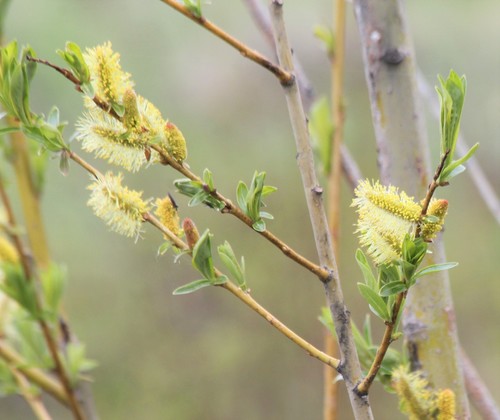
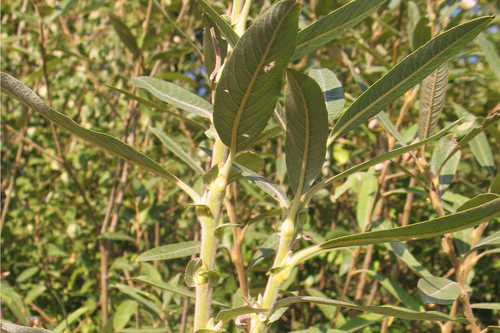
Salix repens, commonly known as creeping willow, is a small shrubby willow species in the family Salicaceae that grows up to 1.5 metres tall. It grows in sand dunes and heathlands, and is a polymorphic species with a wide range of variants. In the UK, these variants span from small, prostrate, hairless plants to taller, erect or ascending silky-leaved shrubs. This broad variation in form has led to a large number of synonyms for the species. This species has a Eurosiberian Boreo-temperate distribution, and is widely distributed across the coasts of western and northern Europe. In the UK, prostrate subspecies (ssp. argentea and ssp. repens) are characteristically found on sand dunes, growing close to the water table in dune slacks. They also grow in coastal heaths, acid grassland, and inland heaths and moorland. The erect variety (var. fusca) grows in fens. In the southern and eastern parts of its UK range, the species is restricted to moist or wet habitats. It has been recorded from sea level up to 855 metres (2,805 ft) in East Perthshire. Dune habitats that include Salix repens are recognized as ecologically important under the EU Habitats Directive, and over 132 Natura 2000 sites are designated for this habitat type. As the water table drops in dune slacks, Salix repens-dominated habitats called Salicion arenariae may develop into either mesophilous (neither wet nor dry) or xerophilous (dry) communities. Mesophilous communities can include species like Pyrola rotundifolia, Viola canina and Monotropa hypopitys, while xerophilous communities host Carlina vulgaris and Thalictrum minus. Salix repens offers shelter to other plant and animal species. Its soft, fluffy seed hairs serve as nesting material for songbirds, and a diverse group of unusual fungal species often grows near it in autumn. If the dune slack it inhabits becomes covered by an advancing dune, the species can adapt by shifting its growth form from erect to prostrate. By losing its erect habit, it can creep horizontally along the advancing dune face and survive changing conditions. Research indicates that mycorrhizal fungal associations help Salix repens expand the range of ecological niches it can occupy.