About Salix purpurea L.
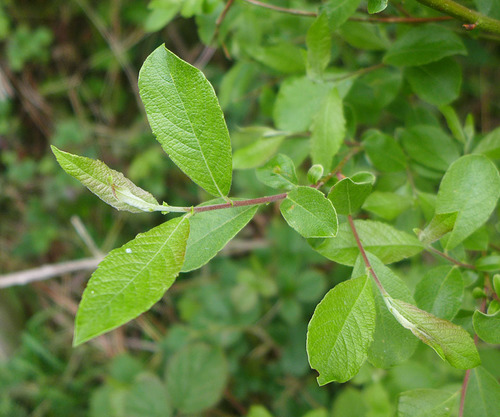
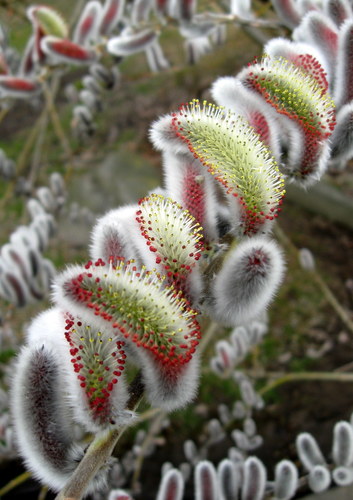
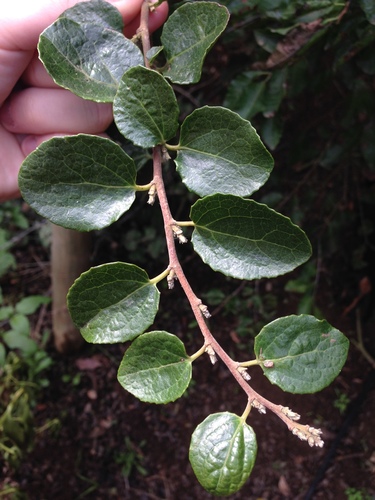
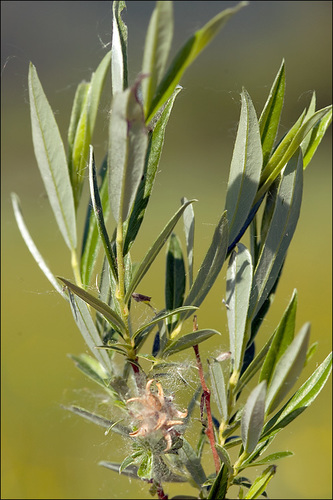
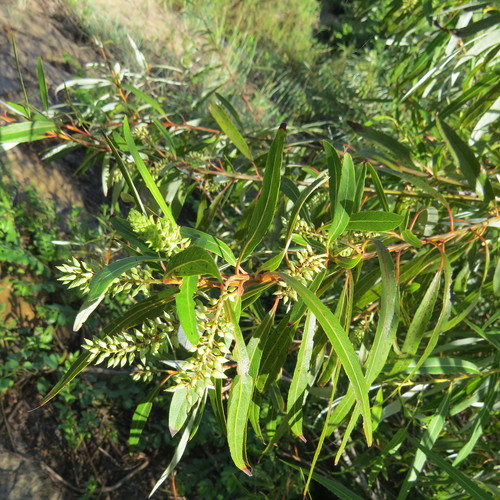
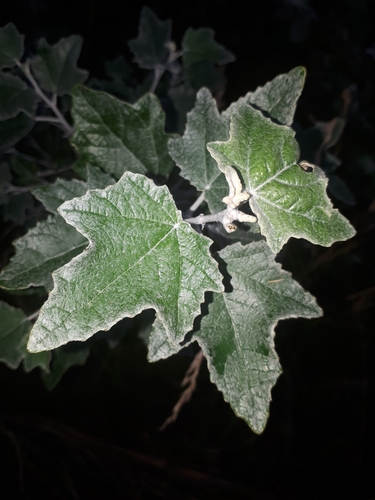
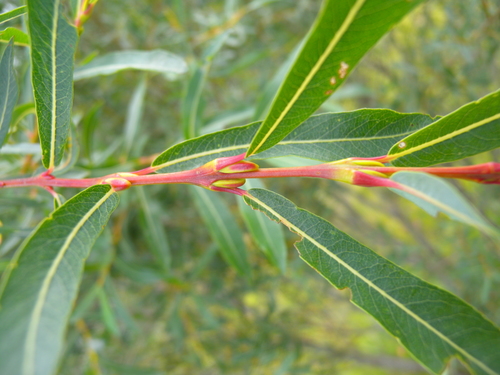
Salix purpurea L., commonly known as purple willow, is a dioecious shrub or small tree that reaches around 5 meters in height, and typically grows multiple stems. Its bark is greyish, smooth, and bitter-tasting, and all vegetative parts of the plant are completely glabrous. Twigs and young branches are terete, flexible, and often yellowish or purple-tinged. Unusually for a willow, its leaves are opposite or nearly opposite, with a narrowly oblong shape and a pointed tip. Leaves range from 2 cm to 10 cm long, and each leaf is covered by a single scale when in bud. Fresh leaves are characteristically dull pale green, and turn black when stems are harvested. Leaf margins are entire, or slightly serrated near the tip; petioles are very short, and stipules usually drop off early. Catkins emerge before leaves in spring, and each plant bears either male or female catkins (the species is dioecious). Catkins are narrowly cylindrical, usually held upright, and measure approximately 3 cm long by 0.5 cm wide. Each catkin is typically subtended by 2 to 3 small bracts. The rhachis is densely hairy, as are the black catkin scales that act as bracteoles subtending each individual flower. The perianth (sepals and petals) is reduced to 1–2 tiny nectaries. Male catkins hold flowers with 2 long stamens that extend past the scales, with red anthers that open at maturity to expose bright yellow pollen. Female catkins have 2 bifid stigmas on a very short style. The fruit is a capsule around 4 mm long by 2 mm wide, with a plume of hairs growing from its base. The species’ native range covers southern Europe and North Africa, extending north to Denmark, and east to Turkey and the Baltic states. Plants found further east than western Russia belong to a different species within the Salix purpurea species group. Britain may lie at the northern edge of its native range, or it may be an introduced species there, similar to its status in Scandinavia. It has been introduced to many other regions of the world, most commonly as an ornamental plant, and is naturalised in North American wetlands. Its altitudinal range extends from sea level up to 1,400 m in Britain, 2,000 m in the Alps and Pyrenees, and up to 2,500 m in the Atlas mountains at the southern edge of its native range. Both globally and in Britain, its conservation status is LC (least concern). In most British counties, it is classified as an axiophyte, because it is restricted to high-conservation-value wetlands regardless of whether it is native to the area. Within its native range of southern Europe and North Africa, purple willow is the characteristic species of EUNIS habitat F9.122 Western Mediterranean purple willow scrub, which consists of stands of purple willow, olive willow, and almond willow lining watercourses. It also grows in riverside scrub in Britain and northern France; in Britain, this habitat is classified as W6 Salix fragilis woodland. In this location, it may be native but is more likely to have been planted, as osier beds were historically cultivated on floodplains. Another habitat where it occurs in Britain is beside lakes such as the ancient glacial lakes of the Meres and Mosses region of the Shropshire-Cheshire plain. Here it grows in grey willow carr, sometimes in standing water, and is considered an indicator of ancient woodland. Its habitat in France is very similar to that in Britain. Its Ellenberg-type indicator values are L=8, F=8, R=8, N=5, S=0, indicating a preference for full bright sunlight, very wet conditions, base-rich water, low fertility, and no salinity. A great many organisms are associated with purple willow. The Plant Parasites of Europe website lists 247 species: 209 insects, 25 fungi, 12 mites, and one single-celled organism. Among the insects are 39 beetle species, 62 true bugs, 23 bees, wasps and ants, and 61 Lepidoptera (butterflies and moths). Three of these associated species may be monophagous on purple willow. Euura salicispurpureae is a mite that forms galls in young shoots of purple willow and its hybrids; Aculus truncatus is another mite that galls purple willow leaf margins, causing curling; Rabdophaga purpureaperda is a midge that forms galls in shoot tips. Other notable parasites include the sawfly Euura proxima, which produces red bean-shaped swellings on the upper leaf surface of purple willow and other willows; Euura viminalis, which creates spherical pale green galls on the lower leaf surface of purple willow or common osier; Rabdophaga degeerii, which causes shoot swellings in northern Britain; and the poplar hawkmoth, whose larvae feed on willow leaves. Willows are largely pollinated by insects; the flowers produce a distinctive scent to attract bees, flies, and other pollinators, and are a useful early-season nectar source to support insect populations. There is also some evidence that willows can also be pollinated by wind. Purple willow has long been used for basket making, and is still harvested for this purpose. When used for basketry, it is often called "Brittany Green" willow, valued for its purple colour and evenly sized stems that retain a consistent thickness along their length. Historic withy beds were often planted with multiple willow taxa: British botanist Charles Sinker documented a withy bed at Crew Green in Wales that contained five species and three hybrids. The weeping cultivar 'Pendula' has earned the Royal Horticultural Society's Award of Garden Merit. Like other willows, its shoots (called withies) are commonly used for basketry, and its wood is used alongside that of other willow species to make cricket bats. Roman herbalist Dioscorides documented multiple uses for willow: taken with pepper and wine, it was said to help with intestinal obstruction or act as birth control; leaf juice mixed with other ingredients was used to treat ear sores; burned bark mixed with vinegar was said to remove calluses and corns. Nicholas Culpeper suggested that placing willow boughs around a chamber would refresh people suffering from fevers. More modern herbalists make far less use of willow, and Mrs Grieve did not mention purple willow at all. This may be because consuming purple willow can cause side effects including gastrointestinal bleeding and kidney damage, and simply eating the leaves can lead to severe abdominal pain.