About Salix pentandra L.
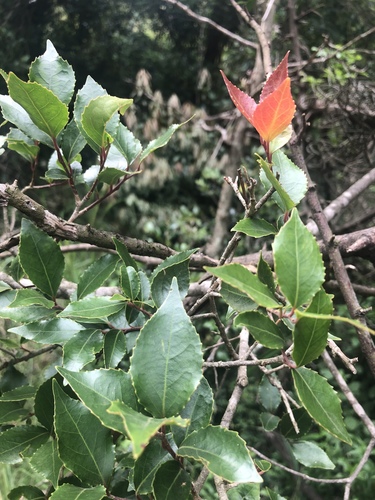
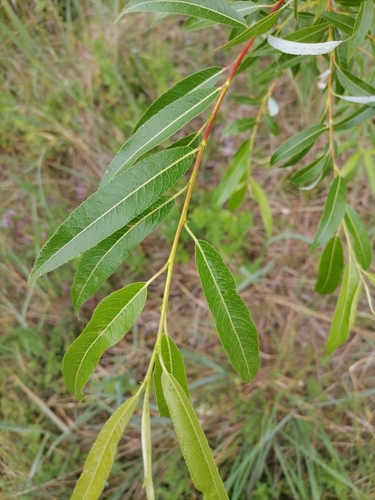
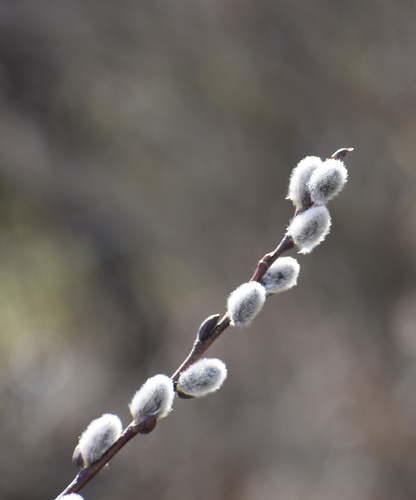
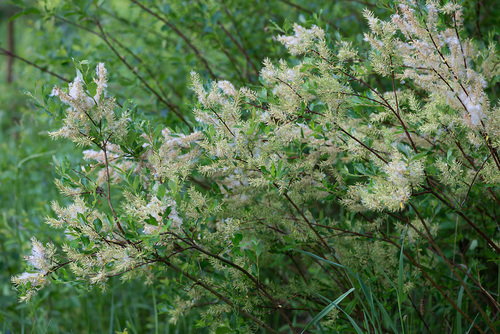
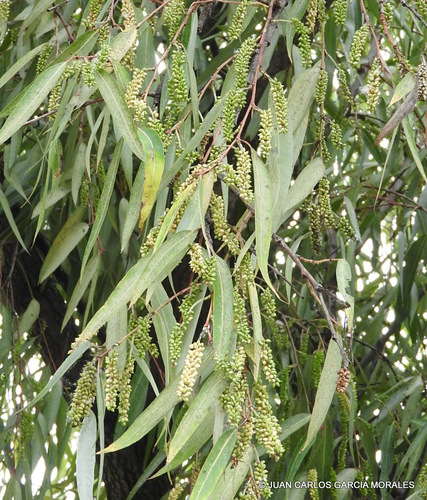
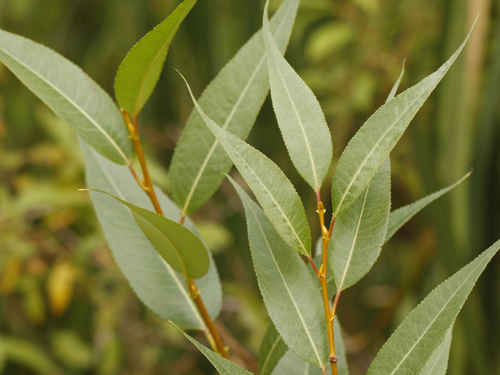
Salix pentandra L., commonly called bay willow, is a large shrub or small tree that typically reaches 14 m (46 ft) in height, and rarely grows as tall as 17 m (56 ft). It usually grows in wet, boggy ground. Its leaves are glossy dark green, measuring 5–12 cm (2.0–4.7 in) long and 2–5 cm (0.79–1.97 in) wide, with finely serrated margins. The species produces dioecious flowers in the form of catkins, which emerge in late spring after the leaves have grown. Male catkins are yellow and 2–5 cm long, while female catkins are greenish and 1.5–3 cm (0.59–1.18 in) long; pollination is done by bees. The fruit is a small capsule that holds numerous tiny seeds, each embedded in white down that helps with wind dispersal.
Bay willow is native to northern Europe and northern Asia. In the British Isles, it is most common in Scotland and northern England, and is sometimes planted as an ornamental tree in other parts of the region. It grows alongside rivers and streams, on marshy ground, and in wet woodland. It grows beside Llyn Bedydd in Wrexham County Borough, Wales, where it is an uncommon plant. It has become locally naturalized in northern North America, where it is known as laurel willow.
Ecologically, bay willow foliage serves as a food source for the larvae of several moth species, including Ectoedemia intimella, whose larvae feed inside leaf tissues as leaf miners. The catkins produce nectar and pollen early in the year, attracting bees and other insects. This willow species is susceptible to watermark disease, a condition that causes branch dieback, caused by the pathogenic bacterium Brenneria salicis.