About Salix pedicellata Desf.
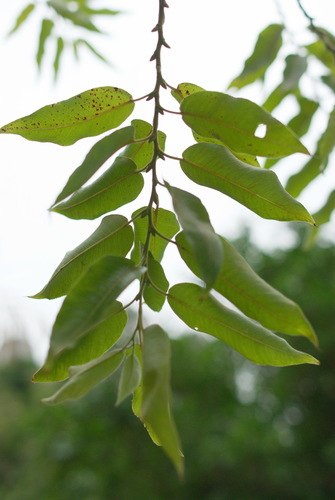
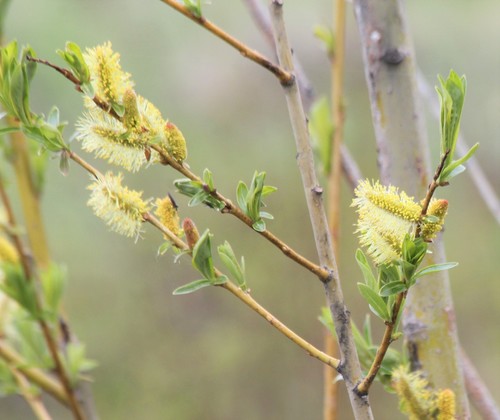
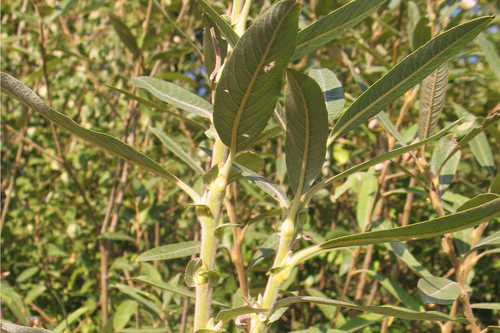
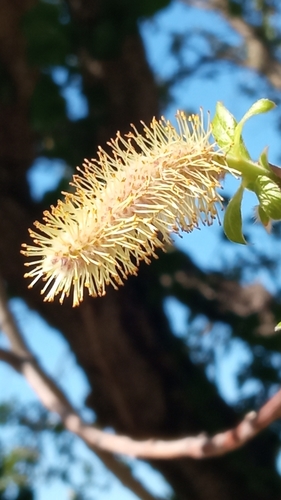
Salix pedicellata Desf. is a plant species that is highly variable in overall appearance. It grows as a shrub or small tree, reaching a height of 6 to 8 meters. Its trunk may grow up to 1.4 meters long, though it is typically shorter. The plant's twigs are dark brown; they are initially covered in short hairs (tomentose) and become smooth (glabrous) as they mature. When bark is stripped from a twig, distinct longitudinal ridges or lines can be seen. The leaves of Salix pedicellata are roughly oblong in shape, measuring 4 to 16 cm long and 1 to 5 cm wide. The upper surface of a leaf is green, while the lower surface is greyish and has prominent veins. S. pedicellata flowers in early spring, which corresponds to February to April in its native range. Male catkins are typically densely flowered and 2 to 4 cm long. Female catkins are less densely packed, usually allowing the stem to be visible, and are slightly longer at 5 to 8 cm. Both male and female flowers have only one nectary. The seeds are black to olive in color, cylindrical in shape, and measure roughly 1.25 mm long by 0.5 mm wide. Salix pedicellata subsp. pedicellata is native to select countries around the Mediterranean: in Europe it is found in Portugal, Spain, Sicily, mainland Greece, and Crete, with an uncertain presence in mainland Italy; in western North Africa it occurs in Morocco, Algeria, and Tunisia; and in Western Asia it is native to the East Aegean Islands, Turkey, and Lebanon-Syria. This subspecies has been introduced to Ethiopia. Salix pedicellata subsp. canariensis is native to Madeira and the Canary Islands.