About Salix nigra Marshall
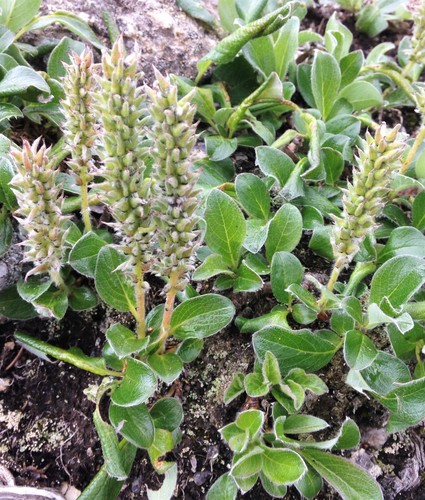
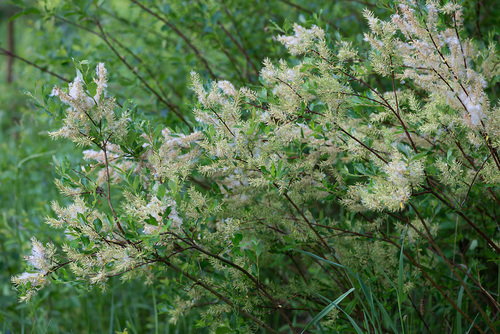
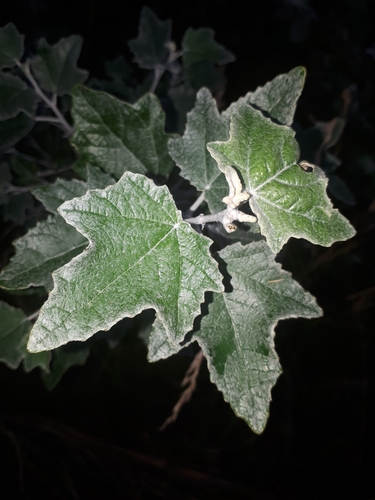
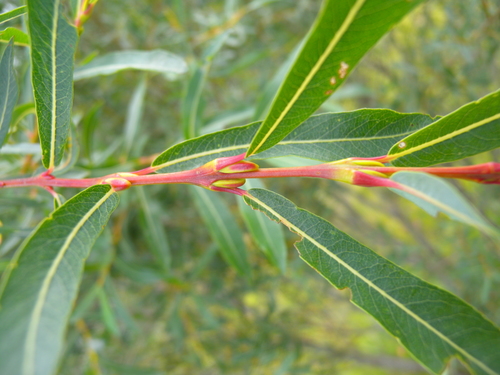
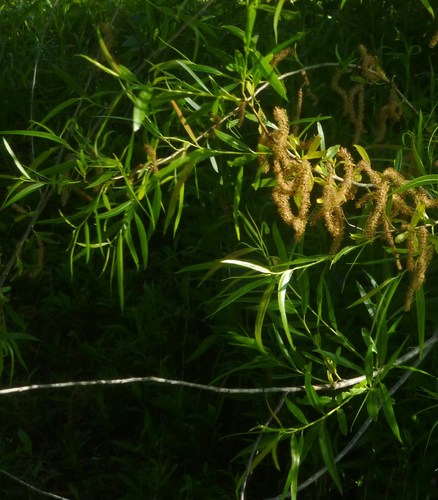
Salix nigra Marshall, commonly called black willow, is a medium-sized deciduous tree, and the largest willow species native to North America. It typically grows 10–30 m (35–100 ft) tall, and may reach exceptional heights of up to 45 m (148 ft), with a trunk 50–80 centimeters (20–30 in) in diameter. Its bark is dark brown to blackish, becoming fissured on older trees, and the trunk frequently forks near the base. Shoots are slender, and their color ranges from green to brown, yellow, or purplish; like the related European species Salix fragilis, these shoots are brittle at the base, and will snap evenly at the branch junction if bent sharply. Foliage buds are 2–4 millimetres (1⁄16–3⁄16 in) long, covered by a single, pointed reddish-brown bud scale. Leaves are alternate, long and thin, measuring 5–15 centimeters (2–6 in) long and 0.5–2 centimeters (1⁄4–3⁄4 in) broad, and are usually somewhat falcate. They are dark, shiny green on both surfaces, or have a lighter green underside, with finely serrated margins, a short petiole, and a pair of small stipules. In autumn, the leaves turn lemon yellow. This species is dioecious, with small greenish yellow to yellow flowers that grow on catkins 2.5–7.5 centimeters (1–3 in) long. Flowers emerge in early spring, at the same time new leaves appear. The fruit is a 5 millimeter (3⁄16 in) capsule that splits open when mature to release many tiny, down-covered seeds. It is native to a large area of North America, ranging from New Brunswick and southern Ontario west to California and Arizona, and south to northern Florida and Texas. It also occurs in parts of Mexico, both south and west of the Rio Grande, and has been introduced along streams in the state of Utah. Black willow grows best in full sun and wet or moist soils, so it is typically found along streams and in swamps. As a dioecious species, Salix nigra has separate male and female individual trees. Its flowering time is climate-dependent: it flowers in February in the southern part of its range, and does not flower until June in the northern parts. Trees begin producing seeds when they are around 10 years old. This species produces consistent good seed crops year after year, with only occasional failures. Seeds require very specific conditions to germinate, and prefer very wet or flooded soil. After germination, seedlings grow very well when they receive high sunlight and abundant moisture during the growing season. Black willow develops special adaptations to survive flooded habitats: under flooded conditions, it produces hypertrophied lenticels and water roots. It is sensitive to drought, and drought conditions inhibit branch and root growth in this species. Early in the growing season, some Salix genus species typically produce leaves with a denser covering of indumentum (red or brown hairs) than leaves produced later in the season. Salix produces two types of leaves: preformed first leaves that grow directly from the bud, and neoformed new leaves that develop as the branch continues extending outward. Black willow roots have a very bitter taste, and were historically used as a quinine substitute. Various Native American tribes used black willow for ethnobotanical purposes including basketry, and treating fever, headache, and coughs. It is the only willow native to the United States harvested for timber, which is used to make a variety of items including furniture and shipping containers. At its peak production in the 1970s, the largest black willow timber production site was in Louisiana. The wood of Salix nigra is very lightweight, and was once used to make artificial limbs like wooden hands. It holds its shape well, does not splinter easily, and has moderately high shock resistance that lets it withstand continuous moderate impacts. It is also used in environmental restoration, especially for erosion control. Black willow is highly resistant to herbivory and flooding, so it is used for marshland stabilization or restoration projects, as long as its roots do not penetrate any existing clay liner. It has shown some success as a photodegradation tool: it is thought to work by pulling target chemicals such as bentazon up through the roots and stem into the leaves, where the chemicals are degraded by high-energy solar radiation.