About Salix integra Thunb.
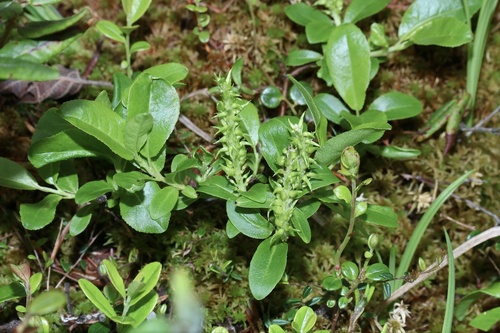
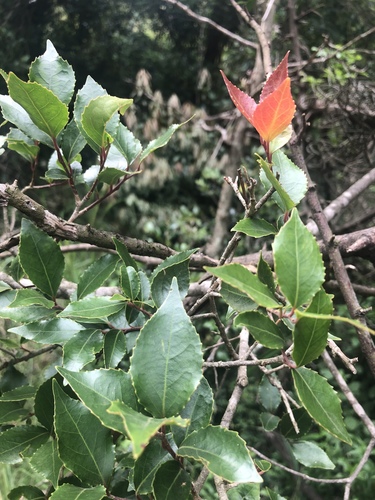
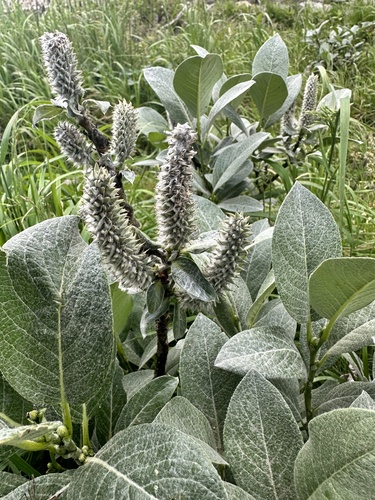
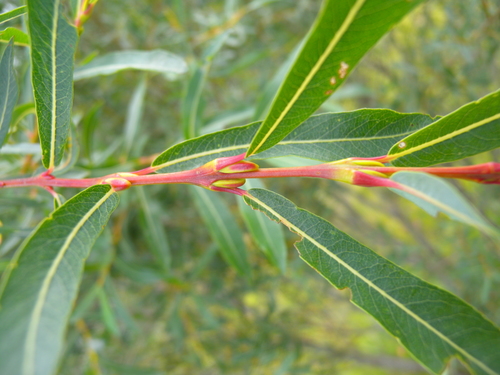
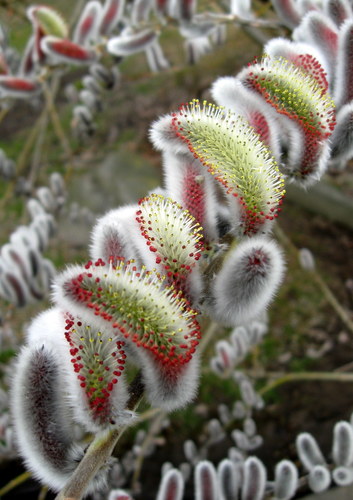
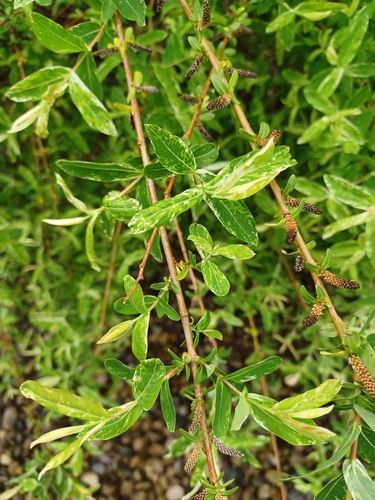
Salix integra Thunb. is a species of willow that is native to northeastern China, Japan, Korea, and far southeastern Russia (Primorsky Krai). It is a deciduous shrub that grows 2–6 meters tall, with greyish-green bark and reddish to yellowish shoots. Its leaves measure 2–10 cm long and 1–2 cm wide, and are pale green on both the upper and lower surfaces. Unusually for willows, its leaves are most often arranged in opposite pairs or whorls of three, rather than the alternate arrangement common in the genus. Its flowers form small catkins 1–2.5 cm long that emerge in early spring, and range in color from brownish to reddish. The species is dioecious, meaning male and female catkins grow on separate individual plants. It is closely related to Salix purpurea, a willow native to Europe and western Asia, and some authors have treated it as a variety or subspecies of S. purpurea, under the names S. purpurea var. multinervis (Franchet & Savatier) Matsumura and S. purpurea subsp. amplexicaulis (Chaubard) C.K.Schneid. The cultivar 'Hakuro Nishiki', commonly called dappled willow, is widely grown as an ornamental plant valued for its variegated foliage. Its leaves are heavily mottled with patches and blotches of white and pale pink. This cultivar has a fairly weak, shrubby growth habit, so it is most commonly sold grafted onto the top of a straight stem from another willow variety. 'Hakuro Nishiki' has received the Royal Horticultural Society's Award of Garden Merit. For the first three years after planting, Salix integra 'Hakuro Nishiki' is typically pruned into a globe shape. After that, growers should check the main stem below the pruned head and remove all unwanted growth from the stem completely. Since Salix integra is generally grafted onto a fast-growing willow rootstock, any growth that emerges from the main stem below the grafted head is unwanted and should be pruned away.