About Salix hastata L.
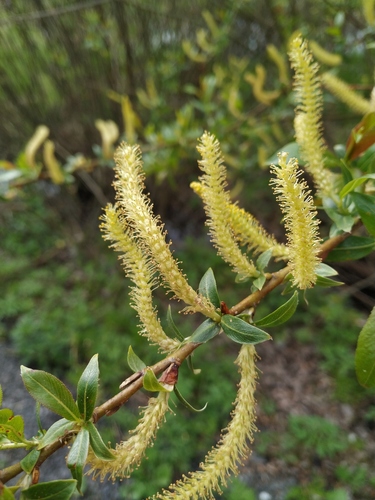
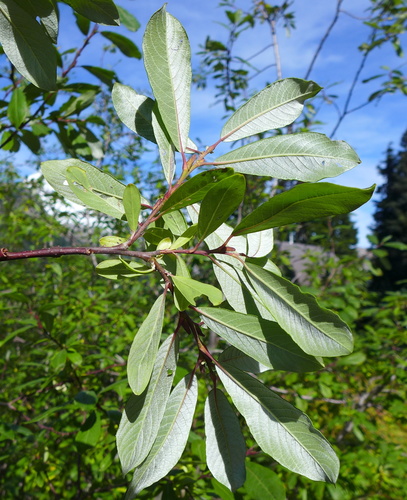
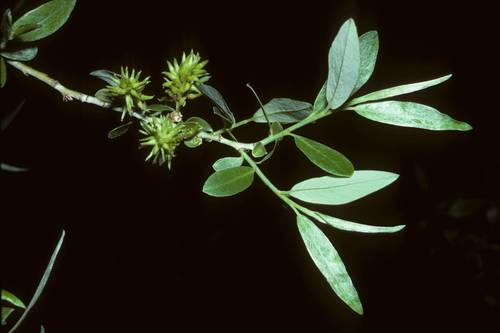
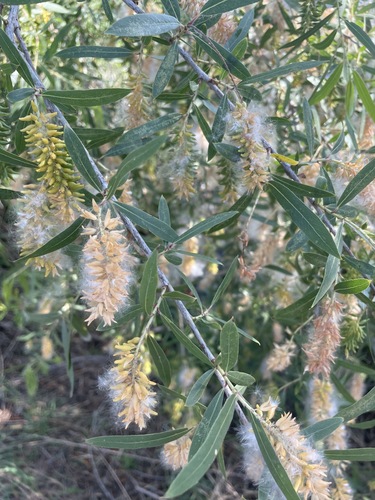
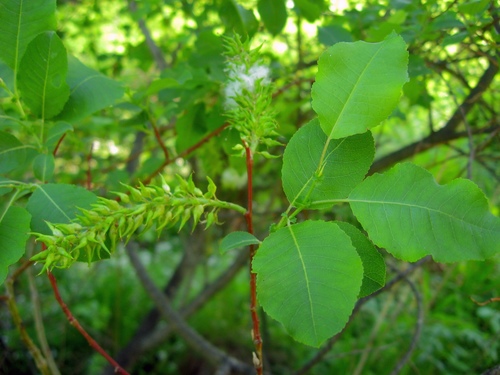
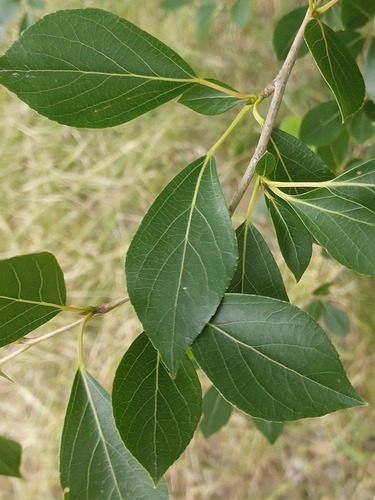
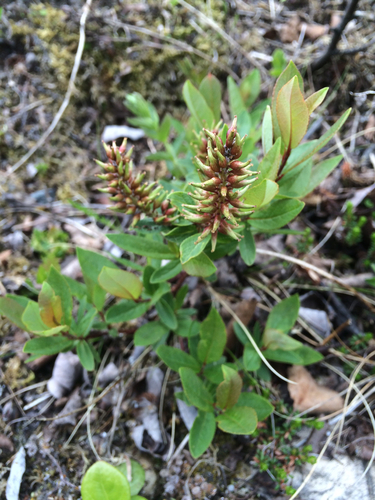
Salix hastata L., commonly called halberd willow, is a willow species that varies widely in appearance based on environmental conditions. Most often it is a shrub 1 to 2 meters tall, though it can grow up to 4 meters, and it forms thickets. Its deciduous leaves are arranged alternately, grow up to 9.2 centimeters long, and are often hairy, particularly on the leaf undersides. This species is dioecious, meaning male and female reproductive structures grow on separate individual plants. Its inflorescence is a catkin that reaches up to 5 centimeters long. Flowers are pollinated mainly by bees, and seeds germinate immediately when they come into contact with a growing substrate.
This species forms thickets on slopes and riverbanks in Arctic regions, alpine climates, and tundra. It acts as a pioneer species that colonizes recently cleared habitat, such as water-scoured floodplains and recently burned areas. Documented associated species include Barclay willow (Salix barclayi), Alaska willow (Salix alaxensis), tealeaf willow (S. pulchra), Richardson willow (S. lanata ssp. richardsonii), black cottonwood (Populus trichocarpa), alder (Alnus spp.), sedges (Carex ssp.), and mosses (Polytrichum ssp.). On the Alaska North Slope, Salix hastata grows as a low-growing shrub. Sites that supported this and other low-growing willow species before disturbance for the Trans-Alaska Pipeline System construction were observed to be recolonized by these low-growing willows within four years after disturbance ended. Natural regeneration of low-growing willows like S. hastata was successful on moist riparian sites with silty soils, where the species grew alongside taller Alaska willow, and also on dry sites with fine-textured soils.
Halberd willow and Barclay willow have similar appearance and distribution, and misidentifications have been recorded in parts of Alaska. The two species can be distinguished by the sparse reddish hairs found on the main leaf vein of halberd willow, and they can also form natural hybrids with one another. Halberd willow serves as a food source for a number of mammal and bird species. It is not considered an important browse plant for moose, as it is less palatable than other willow species including Alaska willow, tealeaf willow, sandbar willow (S. interior), and littletree willow (S. arbusculoides). On the Alaska North Slope, low-growing willows including halberd willow, tealeaf willow, sandbar willow, and littletree willow are usually covered by snow through the winter, so they do not act as a winter food source for moose.
This species is cultivated for planting in parks and gardens, and the cultivar 'Wehrhahnii' has received the Royal Horticultural Society's Award of Garden Merit. Native Americans used parts of this willow species, alongside other willows, for medicinal purposes, basket weaving, constructing bows and arrows, and building animal traps. In Yukon, people chewed willow leaves (including those of this species) to treat mosquito bites, bee stings, and stomach aches.