About Salix exigua Nutt.
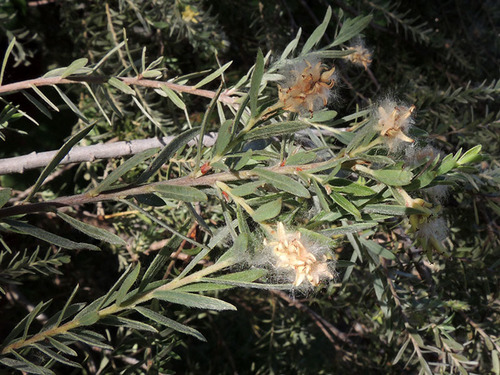
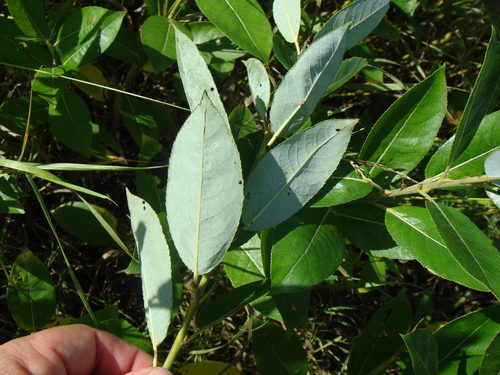
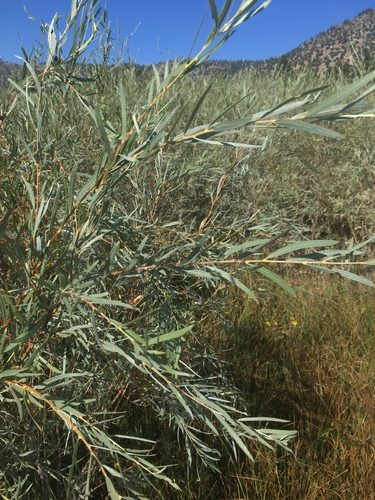
Salix exigua Nutt. is a deciduous shrub that typically grows 4 to 7 metres (13 to 23 ft) tall, and can reach an exceptional maximum height of 7.6 m (25 ft). It spreads via basal shoots to form dense clonal colonies. Its leaves are narrow lanceolate, measuring 4–12 centimetres (1+1⁄2–4+3⁄4 in) long and 2–10 millimetres (1⁄16–3⁄8 in) broad. Leaf color ranges from green to grayish, and is covered in silky white hairs at least when young. Leaf margins are either smooth, or bear a few irregular, widely spaced small teeth. Flowers grow in catkins that form in late spring, after leaves have emerged. This species is dioecious, meaning staminate and pistillate catkins grow on separate plants: male catkins grow up to 10 cm (4 in) long, while female catkins grow up to 8 cm (3 in) long. The fruit is a cluster of capsules, each holding numerous tiny seeds embedded in shiny white silk. In ecology, the male flowers of Salix exigua Nutt. provide pollen for bees. It also acts as a larval host to the California hairstreak, Lorquin's admiral, mourning cloak, sylvan hairstreak, tiger swallowtail, and viceroy. This species is cultivated as an ornamental tree, and in the United Kingdom it has received the Royal Horticultural Society's Award of Garden Merit. Native Americans use this willow for many purposes: its branches are used as flexible poles and building materials, smaller twigs are woven into baskets, and its bark is processed into cord and string. The bark and leaves also have several medicinal uses; specifically, the Zuni people use an infusion of the bark to treat coughs and sore throats. Livestock browse the foliage of this willow.