About Salix discolor Muhl.
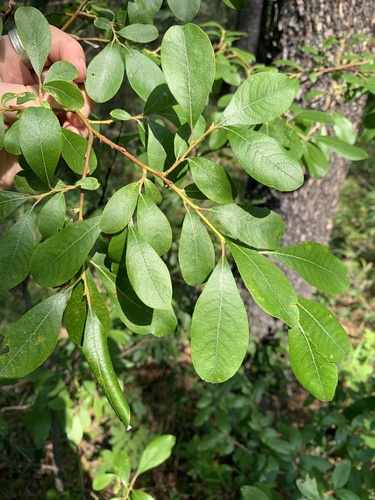
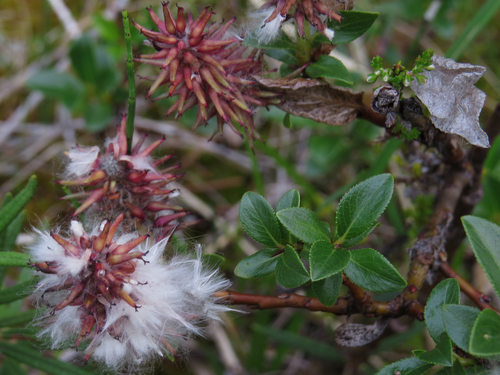
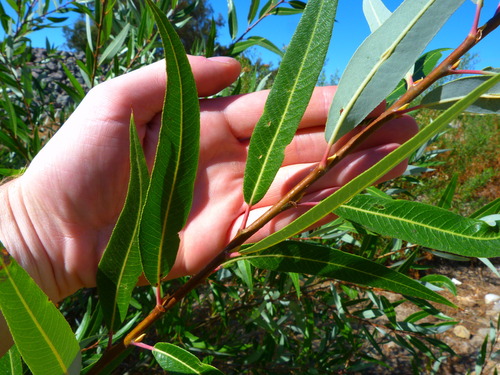
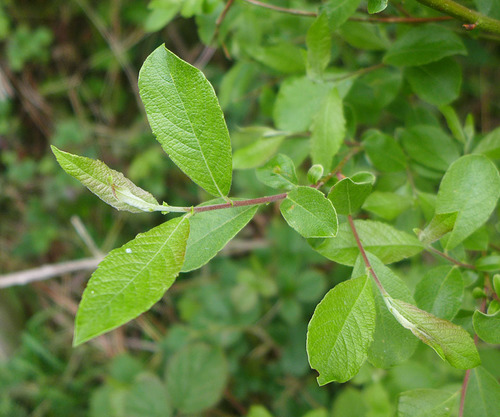
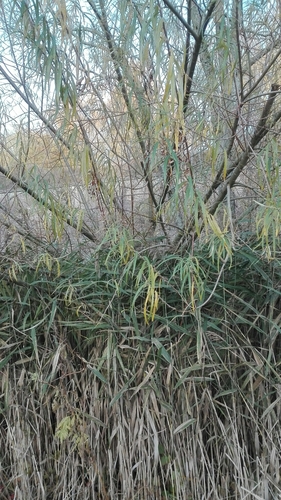
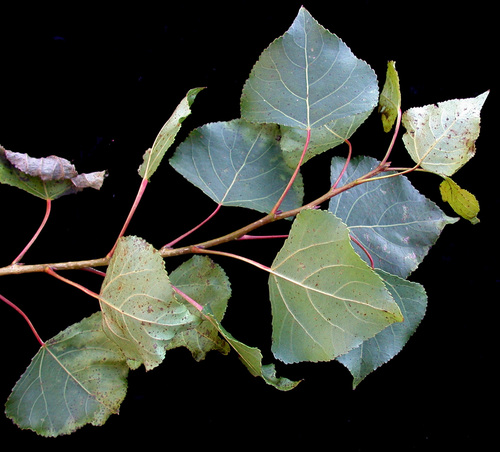
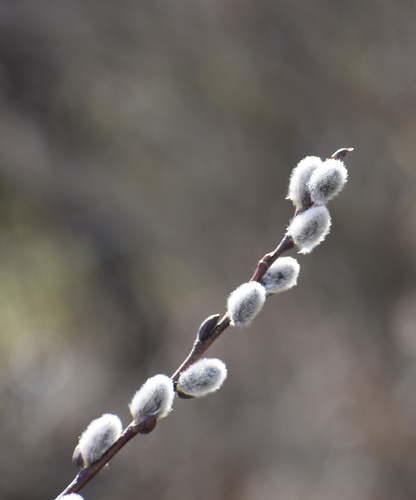
Salix discolor, commonly known as American pussy willow or glaucous willow, is a willow species native to North America, and is one of the two species most commonly called pussy willow. Its native range covers most of Alaska, as well as the northern forests and wetlands of Canada stretching from British Columbia east to Newfoundland. It can also be found in the northern portions of the contiguous United States, ranging from Washington east to Maine, and south to Maryland. This is a deciduous shrub or small tree with weak wood, growing up to 6 m (20 ft) tall, and produces brown shoots. Its leaves are oval-shaped, 3–14 cm long and 1–3.5 cm broad, with green upper surfaces and downy grey-white undersides. It produces flowers in the form of soft silky silvery catkins, which emerge in early spring before new leaves appear. The species is dioecious, meaning male and female catkins grow on separate plants; male catkins turn yellow when they release pollen. The fruit is a small capsule 7–12 mm long, which holds many tiny seeds embedded in cottony down. In its ecology, male flowers of Salix discolor provide pollen for bees. It is also a popular larval host plant, supporting the Acadian hairstreak, black-waved flannel moth, cecropia moth, Compton's tortoiseshell, cynthia moth, dreamy duskywing, eastern tiger swallowtail, elm sphinx, imperial moth, Io moth, modest sphinx, mourning cloak, polyphemus moth, promethea moth, red-spotted purple, small-eyed sphinx, twin-spotted sphinx, and viceroy. Like other willow species, Salix discolor contains salicin, and it was used as a painkiller by Native Americans. Similar to the closely related European pussy willow (Salix caprea), it is commonly cultivated for cut flowers. Its flowering shoots are used as spring religious decorations for Palm Sunday, replacing palm branches that do not grow in most of North America. Multiple Eastern European cultural groups use pussy willows instead of palm branches for Palm Sunday observances. This custom was brought to North America by émigrés from the Ukrainian Orthodox Church, Romanian Orthodox, Russian Orthodox, Ruthenian Catholic, Ukrainian Catholic, Kashubian Catholic and Polish Catholic traditions. Sometimes both palms and pussy willows are blessed in church on Palm Sunday. Blessed pussy willow branches are often preserved for the full year in a family's icon corner. Pussy willow also holds a prominent place in Polish Dyngus Day, also called Easter Monday, observances, a tradition that continues among Polish-Americans today.