About Salix daphnoides Vill.
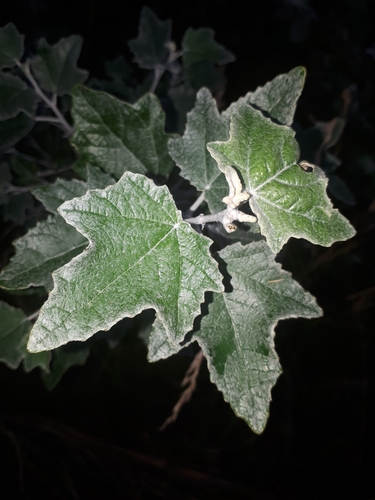
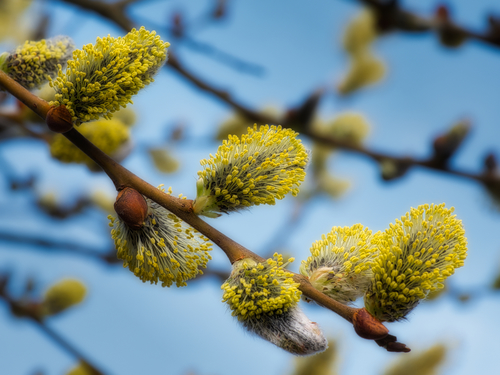
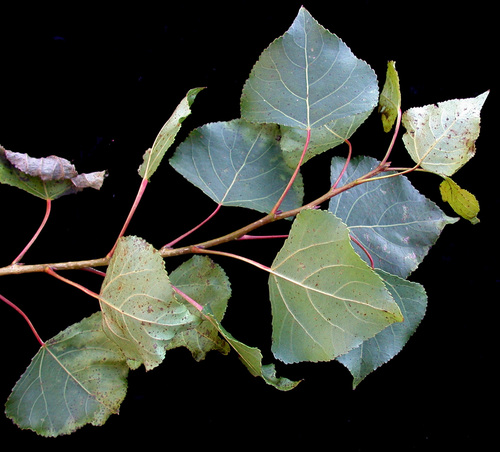
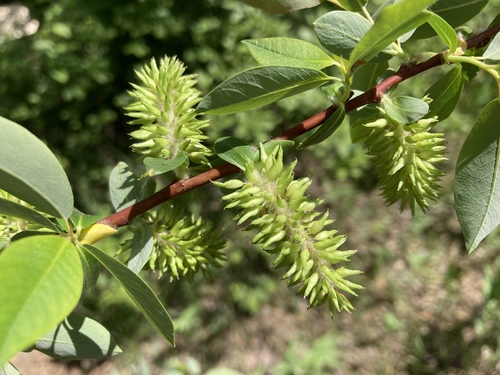
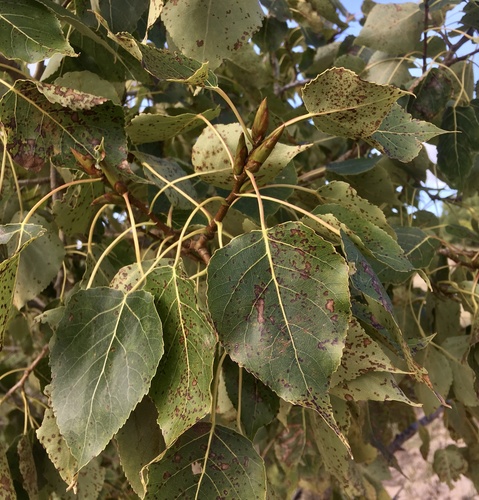
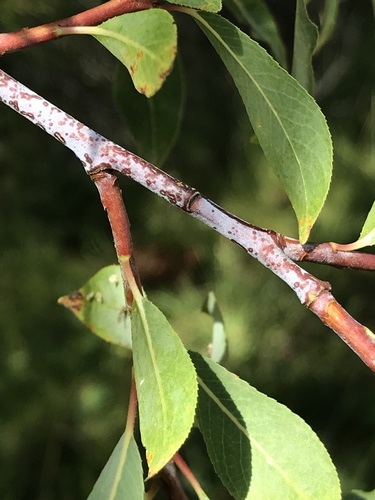
Salix daphnoides Vill. has a rounded crown with spreading branches and smooth grey bark. Its twigs are hairless, somewhat shiny, and coloured dark red to brown. This species produces large buds, which are either hairless or covered in stiff, erect hairs. Its leaves range from oblong to narrow obovate, typically 7 to 12 cm long and 2 to 3 cm wide. Leaves are hairy when young, but quickly become hairless (glabrous); mature leaves are dark shiny green on the upper surface and glaucous on the lower surface. Its catkins emerge between February and March.
Salix daphnoides grows scattered across central Europe, from the Baltic states to Piedmont, and from the Balkans to eastern France. It is native to the Alps, Pyrenees, and Carpathians, but has become naturalized through cultivation across a much wider area. It occurs at altitudes from 100 to 2000 metres (330 to 6560 ft). It grows along river banks and wetlands in alpine regions, preferring alluvial substrates that are sandy, pebbly, or boulder-rich. It also grows into lowland areas, where it occurs along major rivers including the Vistula and the Rhine, often growing alongside Salix eleagnos and Myricaria germanica, and also grows on loose sand dunes.
This species is planted to reinforce coastal and continental sand dunes. It is also widely planted as an ornamental in parks and along roadsides. The cultivar 'Aglaia' has received the Royal Horticultural Society's Award of Garden Merit.