About Salix cinerea L.
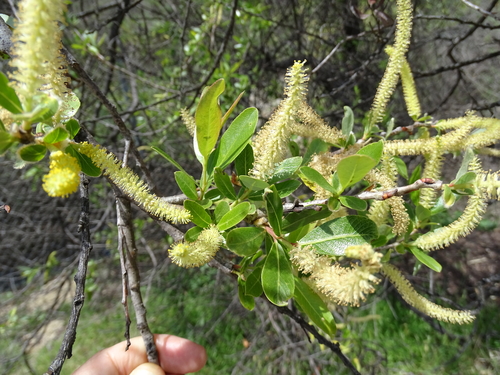
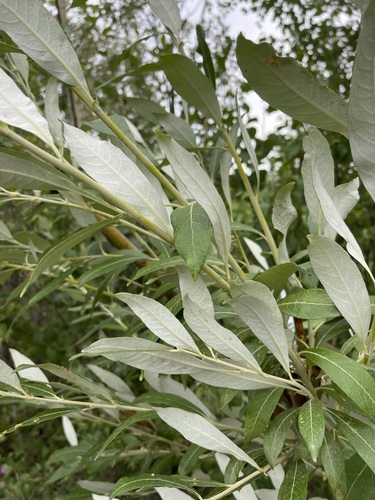
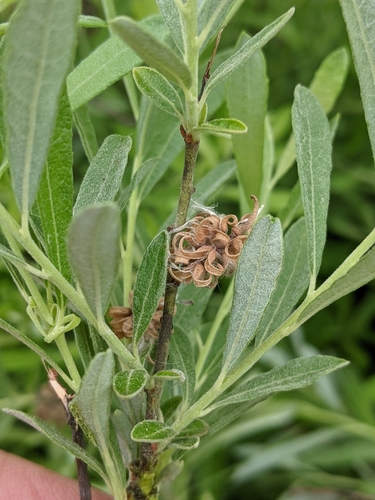
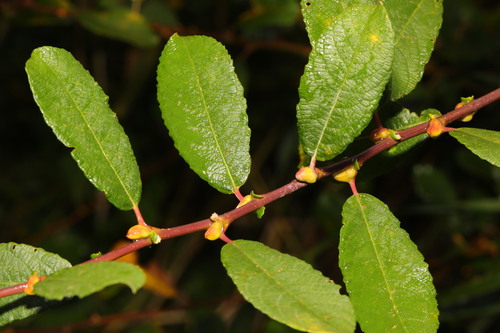
Salix cinerea L., commonly known as grey willow, is a deciduous shrub or small tree that reaches 4–10 metres (13–30 ft) in height. Its leaves are arranged spirally, measuring 2–9 cm (1–3 1⁄2 in) long and 1–3 cm (1⁄2–1 1⁄2 in) broad, though they can exceptionally grow up to 16 cm long and 5 cm broad. The upper surface of leaves is green, while the lower surface is hairy, and leaf margins are crenate. Flowers form in catkins 2–5 cm long that emerge in early spring. This species is dioecious, meaning male and female catkins develop on separate individual plants. Male catkins are silvery when young, and turn yellow once pollen is released. Female catkins are greenish grey, and mature in early summer to release many tiny seeds. Each seed is embedded in white cottony down, which aids wind dispersal of seeds. Grey willow grows in wetlands, moist depressions, ditches, embankments, along the banks of stagnant or slow-moving water bodies, and at forest edges. It occupies low-lying damp locations with waterlogged, nutrient-poor soils. S. cinerea is a pioneer species that quickly colonizes disturbed sites. A common herbivore that feeds on Salix cinerea is Phratora vulgatissima, which prefers female plants and occurs more frequently on these individuals. Anthocoris nemorum, a natural predator of Phratora vulgatissima, is also more commonly found on S. cinerea.