About Salix caprea L.
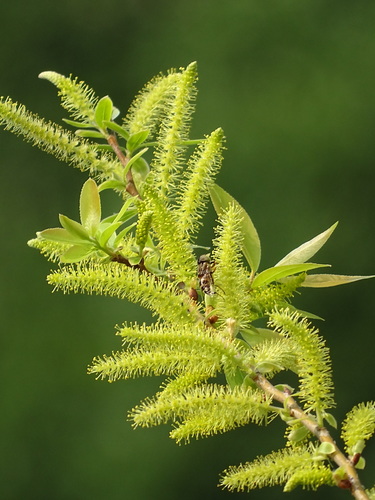
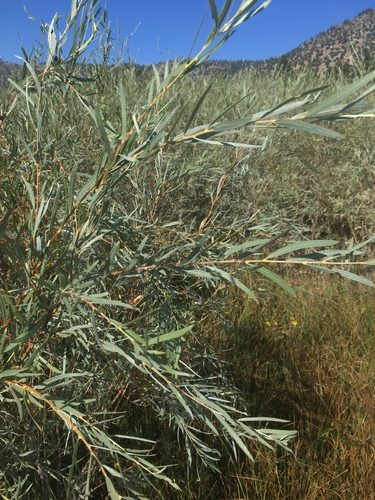
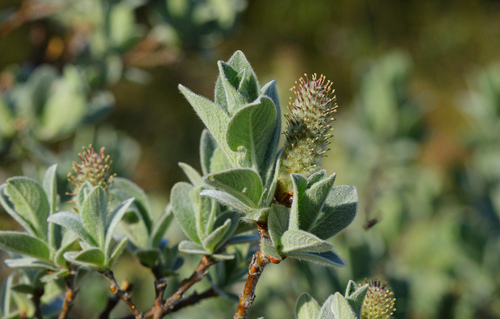
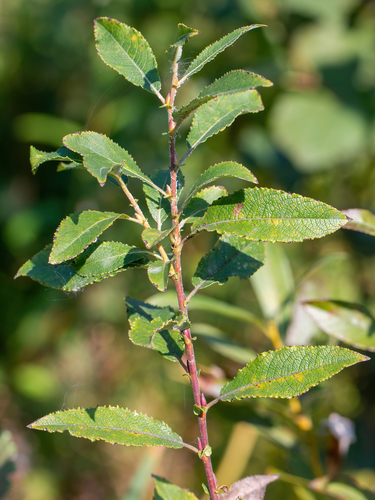
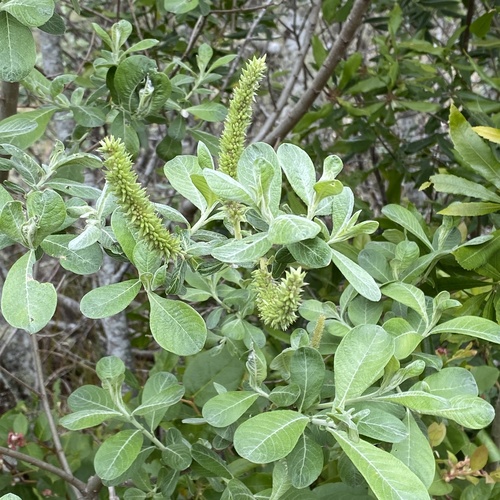
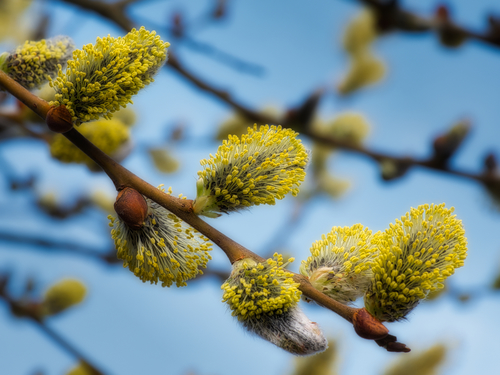
Salix caprea L. is a deciduous shrub or small tree that typically reaches 8–10 m (26–33 ft) in height, and rarely grows as tall as 13 m. Its leaves are 3–12 cm long and 2–8 cm wide, broader than the leaves of most other willow species. It produces soft, silky, silvery catkins 3–7 cm long as flowers, which emerge in early spring before new leaves appear. The species is dioecious, meaning male and female catkins grow on separate individual plants. Male catkins turn yellow when they mature and release pollen, while mature female catkins are pale green. The fruit is a small capsule 5–10 mm long, which holds many tiny seeds embedded in fine, cottony hairs. The seeds themselves are only about 0.2 mm long; the fine hairs help with seed dispersal, and seeds require bare soil to germinate. There are two recognized varieties of Salix caprea L. S. c. var. caprea grows in lowland regions across the entire range of the species. Its leaves are thinly hairy on the upper surface, densely hairy on the lower surface, 5–12 cm long, and have persistent stipules that remain until autumn. S. c. var. sphacelata (Sm.) Wahlenb., which has the synonyms S. caprea var. coaetanea Hartm. and S. coaetanea (Hartm.) Floderus, grows at high altitudes in the mountains of central and northern Europe, including the Alps, Carpathians, Scotland, and Scandinavia. Its leaves are densely silky-hairy on both sides, 3–7 cm long, and have stipules that drop off early. In western Norway, trees of S. c. var. sphacelata reach 18–20 meters tall and mostly grow with single trunks. Ecologically, S. caprea grows in both wet, damp environments such as riverbanks and lake shores, and in drier sites, wherever ground disturbance creates available bare soil. Hybrids between S. caprea and several other willow species are common. These common hybrids include S. × reichardtii (with Salix cinerea), S. × multinervis (with Salix aurita), S. × smithiana (with Salix viminalis), and S. × sordida (with Salix purpurea). Hybrid introgression is often seen in S. caprea populations. Unlike almost all other willows, pure S. caprea specimens do not root easily from cuttings; any willow resembling S. caprea that roots easily is most likely a hybrid with another willow species. The leaves of S. caprea serve as a food source for multiple Lepidoptera species, and are also commonly eaten by browsing mammals. Willows are very susceptible to gall-inducing organisms, and the midge Rhabdophaga rosaria forms camellia galls on S. caprea. A small number of cultivars have been selected for cultivation in gardens. The most common cultivar is S. caprea 'Kilmarnock', a male clone discovered by James Smith that has stiffly pendulous shoots that form a mop-headed shape. A similar female clone is S. caprea 'Weeping Sally'. Because these cultivars do not form a central leader trunk, they are grafted onto the erect stems of other willows; the final height of these cultivated plants depends on the height at which the graft is placed. S. caprea can also be grown from greenwood cuttings, which produce attractive creeping mounds. Hardwood cuttings are often difficult to root. Both tannin and salicin can be extracted from the bark of goat willow. The tree is not considered a good source of timber, because its wood is brittle and known to crackle violently when burned. Like its close relative Salix discolor (American pussy willow), it is often grown to produce cut flowers. Further cultural information that applies to both species can be found under Pussy willow. In North Europe, making willow flutes from goat willow cuttings has been fairly common. In Germany, Hungary, northern Slovakia, Poland, Ukraine, and many parts of Finland, freshly opened catkins of S. caprea are used in the same way olive branches are used for Palm Sunday.