About Salix brachycarpa Nutt.
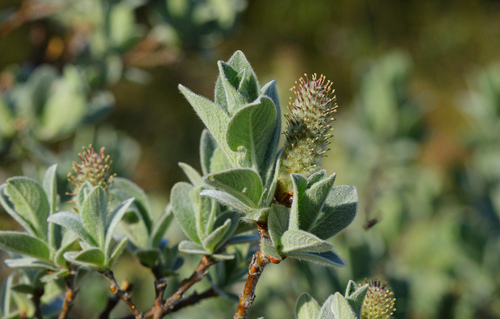
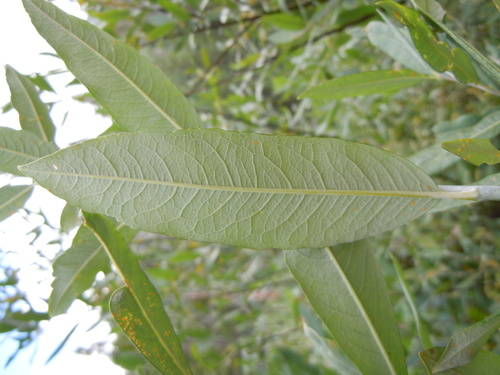
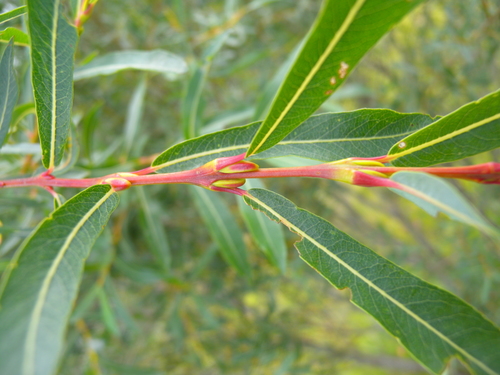
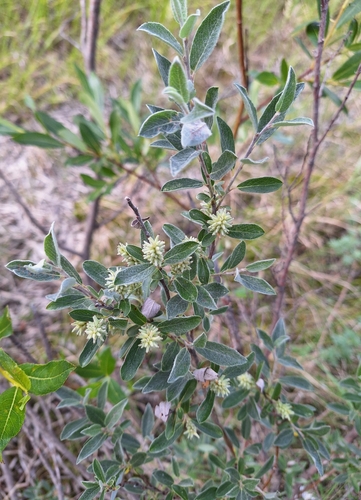
Salix brachycarpa Nutt. is typically a low-growing shrub, and sometimes grows with a prostrate habit, reaching a maximum height of 1.5 metres (4.9 ft). Its stems sometimes have hairs, and smaller branchlets can be quite woolly. Its leaves are also usually hairy, with woolly tissue on their undersides. This species is dioecious, meaning male and female reproductive structures grow on separate individual plants. Its inflorescence is a catkin that can grow up to 5 centimeters long. The plant produces tiny, downy seeds that remain viable for only a few days, but may germinate within 12 hours after landing on a suitable growing substrate. This species is native to North America. Its range covers most of Alaska, excluding the Aleutian Islands and southeastern coastal Alaska, plus western and northern Canada. In the contiguous United States, it grows in the Rocky Mountains extending south to Colorado, and in the Sierra Nevada of California. It occupies a variety of habitat types, including coniferous forests, alpine areas, areas near rivers and streams, bogs, muskegs, swamps, and moraines. It is common on floodplains, where it grows alongside other willow species and many other shrubs. It can also be found growing on serpentine barrens, salt marshes, and salt flats. It readily colonizes wet areas that have recently been cleared of vegetation, such as gravel bars. On the Alaska North Slope, sites that supported this and other low-growing willow species before being disturbed during construction of the Trans-Alaska Pipeline System were observed to be recolonized by low-growing willows including Salix brachycarpa within four years after disturbance stopped. Natural regeneration of this and other low-growing willows was successful on moist riparian sites with silty soils, where the plants grew mixed with the taller Alaska willow (Salix alaxensis), and also on dry sites with fine-textured soils. This willow serves as food for moose in interior Alaska, and has been planted to restore moose habitat on the Alaska North Slope. It is also planted for revegetation projects and used as a windbreak. Salix brachycarpa is one of the few North American native willows that is popular in commercial cultivation. Its cultivar 'Blue Fox' is the most popular, valued for its blue-gray foliage and low growth habit, reaching approximately 1 m in height. Native Americans used parts of this willow species, along with other willows, for medicinal purposes, basket weaving, manufacturing bows and arrows, and constructing animal traps.