About Salix bebbiana Sarg.
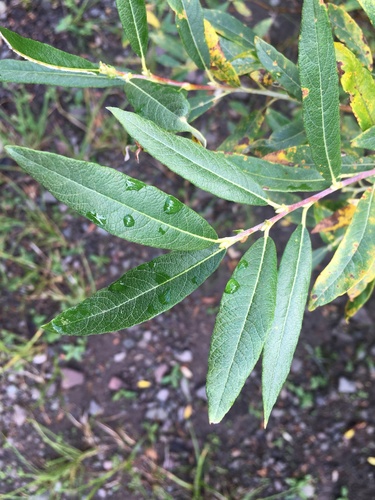
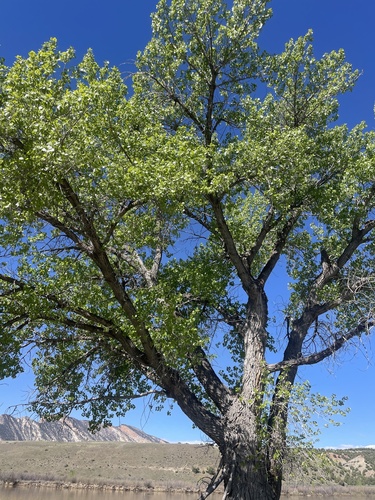
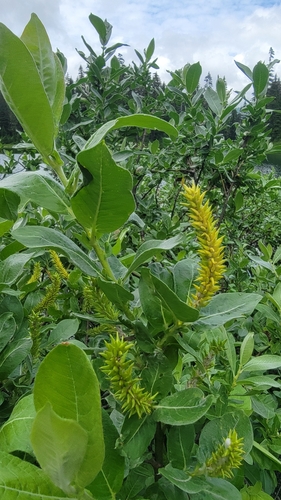
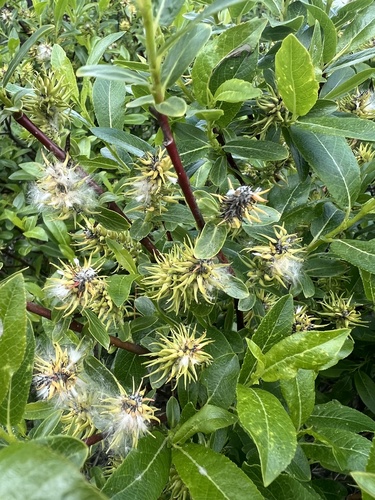
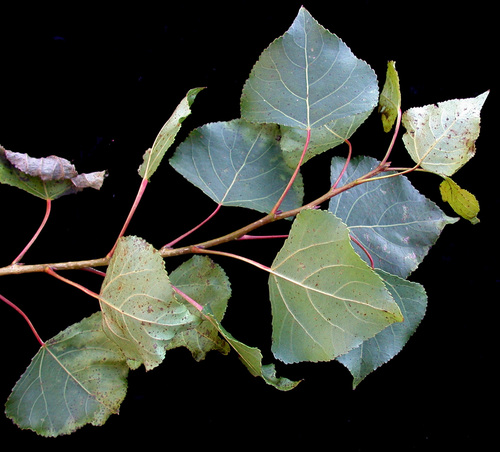
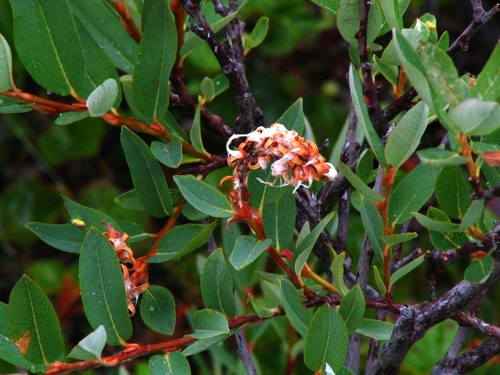
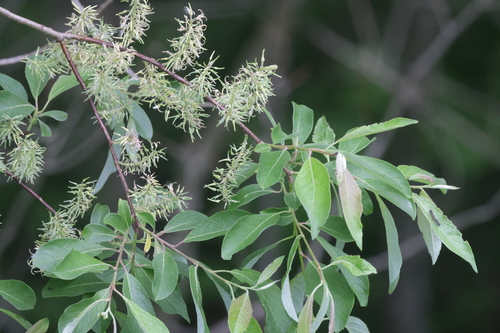
Salix bebbiana Sarg. is a willow species native to Canada and the northern United States, ranging from Alaska and Yukon south to California and Arizona, and northeast to Newfoundland and New England. Its common names are beak willow, beaked willow, long-beaked willow, gray willow, and Bebb's willow. This species was first formally described by Sir John Richardson in the early 19th century under the name Salix rostrata. The name was later changed, because Jean-Louis Thuillier had already used the epithet rostrata for a different Eurasian willow variety. C.S. Sargent renamed it Salix bebbiana to honor American botanist Michael Schuck Bebb. This plant is most commonly a large, fast-growing, multiple-stemmed shrub or small shrubby tree that can form dense, colonial thickets. It grows in loose, saturated soils found on riverbanks, lakesides, swamps, marshes, and bogs. It is also tolerant of heavy clay and rocky soils, making it highly adaptable and durable, and it is a dominant species in many marshland areas within its native range. It reaches 5 to 20 feet in height, with a trunk that can grow up to around 8 inches in diameter. The trunk is short and twisted, and the tree or shrub has a broadly rounded crown. Its leaves are alternately arranged, simple, and ovate, widest near the midrib and tapering to a narrower base and a pointed tip. Leaf edges are generally smooth (entire), though they sometimes have fine serrations. Mature leaves are dull blue-green and smooth in texture, while new leaves are covered in downy hairs. Leaves can grow up to 5 inches long and 1.5 inches wide. Like other willows, Salix bebbiana is dioecious: male and female plants produce small, dangling catkins. Female flowers produce spherical seeds covered in long, threadlike fibers that help the seeds disperse via wind. The plant also spreads through vegetative reproduction: it sprouts from the stem base or root segments, and reproduces by layering. This allows it to form large clonal colonies. It is the most important species of diamond willow, a group of willows that produce fine, colorful wood used for carving. Native Americans use its twigs and branches for basket weaving and arrowmaking. It is an important host plant for 312 species of butterflies and moths. Many parts of the plant are eaten by animals, particularly cattle, which find its foliage palatable for forage. This species readily hybridizes with several other willow species. It currently has no known commercial importance.