About Salix barrattiana Hook.
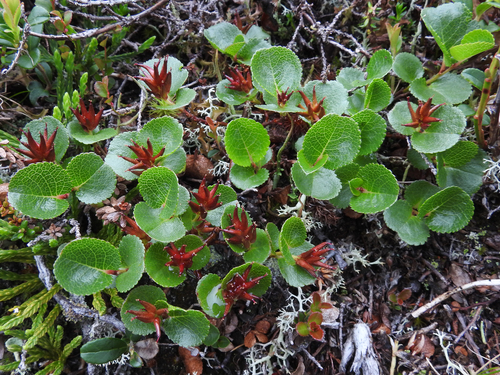
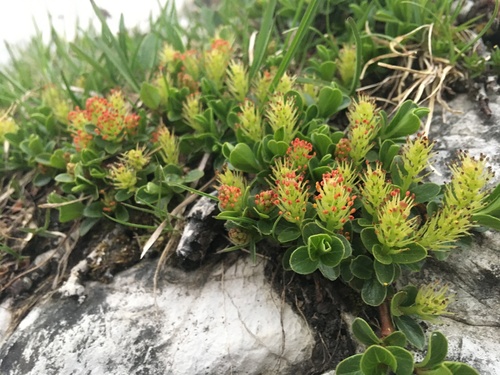
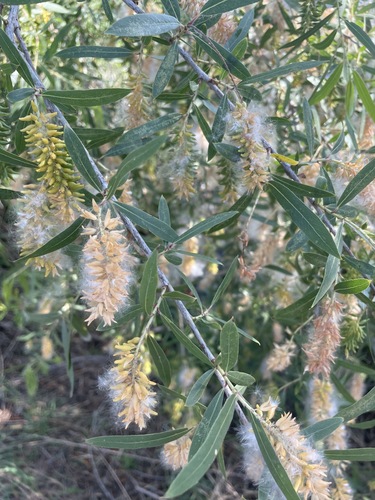
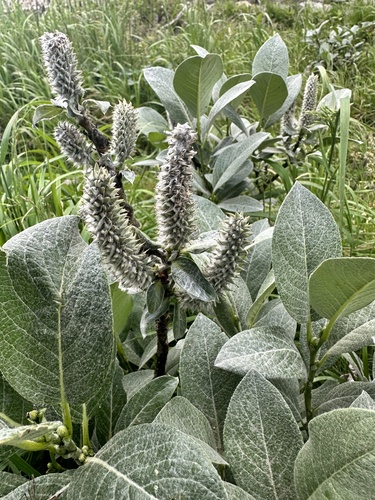
Salix barrattiana Hook. is a species of flowering plant in the willow family, commonly known as Barratt's willow. It is native to North America, with a distribution across Alaska and western Canada, plus a small number of disjunct populations in Montana and Wyoming. These separated populations are thought to be relics from periods when the regional climate was colder. The southernmost known population is technically located in Wyoming, near the Montana state line, and consists of only one all-staminate clone growing within a 100 square meter (1,100 square foot) area of high-elevation habitat. This willow is a shrub that reaches a maximum height of around 1.5 meters (4 feet 11 inches), and it may form dense thickets. Its stems are reddish-brown, and its smaller branches are often purplish. The twigs are sticky with resin and covered in a layer of hairs. Leaves grow up to 9.5 centimeters (3.7 inches) long, have hairy to woolly undersides, and carry a strong balsamic scent. The stipules and buds are very oily, and they will yellow stain plant pressing sheets. The species is dioecious, meaning male and female reproductive structures grow on separate individual plants. Its reproductive inflorescence is a catkin: male catkins grow up to 5 centimeters (2.0 inches) long, while female catkins can reach 9 centimeters (3.5 inches) long, and all catkins are fuzzy. Barratt's willow grows in fir and spruce forests, along rivers and streams, in boggy habitats, and on recent alluvial deposits. It is considered a tundra species. In the southern portion of its range, it occurs at elevations up to 3,200 meters (10,500 feet) above sea level. This willow may hybridize with Salix barclayi, Salix commutata, and Salix pseudomyrsinites. This species is threatened by global climate change.