About Salix arctica Pall.
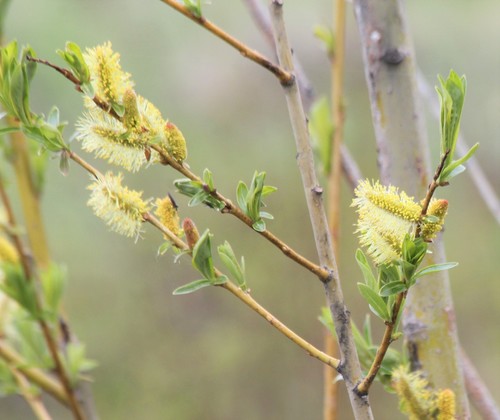
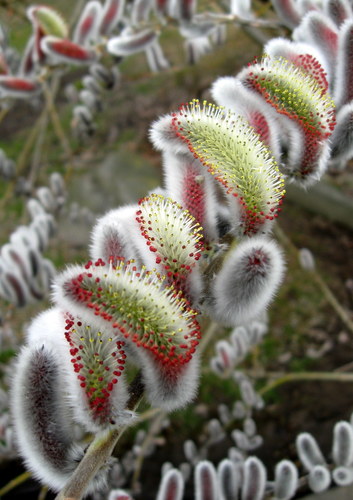
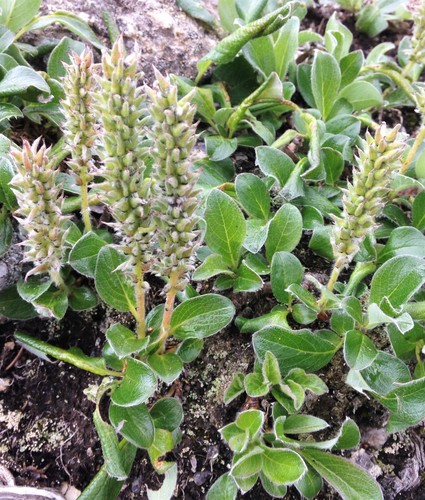
Salix arctica Pall., commonly known as Arctic willow, is typically a low shrub, reaching only 15 cm (6 inches) in height, and rarely grows to 25 cm (10 inches). In the Pacific Northwest, it may reach up to 50 cm (20 inches) in height. It produces round, shiny green leaves that are 1–4 cm (1⁄2–1+1⁄2 inches) long and up to 6 cm (2+1⁄4 inches) broad. The leaves are pubescent, covered in long, silky, silvery hairs. Like all other willows, Arctic willow is dioecious, meaning male and female catkins grow on separate individual plants. This gives the species variable appearance: female catkins are red, while male catkins are yellow. Despite its small size, Arctic willow is a long-lived plant that grows extremely slowly in the harsh Arctic climate. One specimen found in eastern Greenland was determined to be 236 years old. Hybrids between Salix arctica and Salix arcticola, as well as between Salix arctica and Salix glauca, are known to occur. Arctic willow grows in tundra and rocky moorland, and is the northernmost woody plant in the world. It occurs far above the tree line, all the way to the northern limit of land on the north coast of Greenland. It has a circumpolar distribution. In Canada, it grows in the mainland northern territories and the Arctic Archipelago, extending north to Ellesmere Island adjacent to Greenland; it also grows in northern Quebec and Labrador. It is also found in northern Iceland, Fennoscandia, northern Russia, northern Alaska, and Xinjiang, China. Further south in North America, it grows on high-altitude alpine tundra, ranging south to the Sierra Nevada in California and the Rocky Mountains in New Mexico. Arctic willow serves as a food source for multiple Arctic animals. Muskoxen, caribou, Arctic hares, and lemmings all feed on its bark and twigs, while its buds are the main food source for the rock ptarmigan. It is also the primary host plant and food source for the Arctic woolly bear moth, Gynaephora groenlandica. Both the Inuit and Gwich’in peoples use this willow. Twigs are used as fuel. Decayed flowers called suputiit are mixed with moss and used as wicking in the kudlik. The plant has been used for several medicinal purposes: it is used to relieve toothache, help stop bleeding, treat diarrhoea and indigestion, and applied as a poultice to wounds. Both Gwich’in and Inuit peoples in the Bathurst Inlet area are known to eat parts of Arctic willow, which is high in vitamin C and has a sweet taste. A single young leaf of this plant contains 7 to 10 times more vitamin C than an orange. The inner portion of young shoots, excluding the bark, can be eaten raw, even when the shoots are found underground.