About Salix amygdaloides Andersson
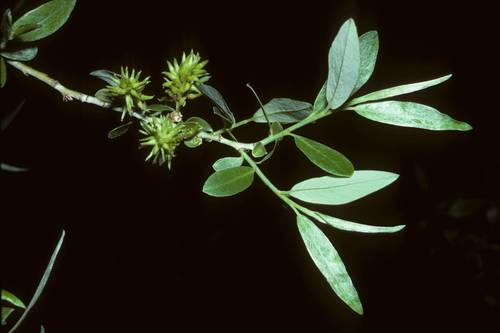
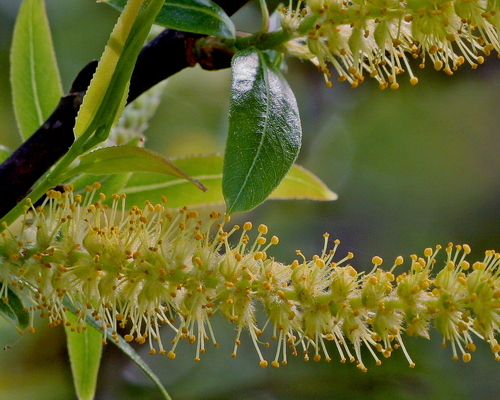
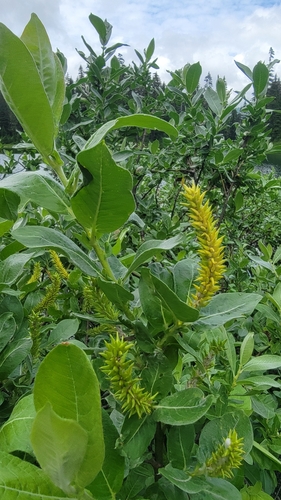
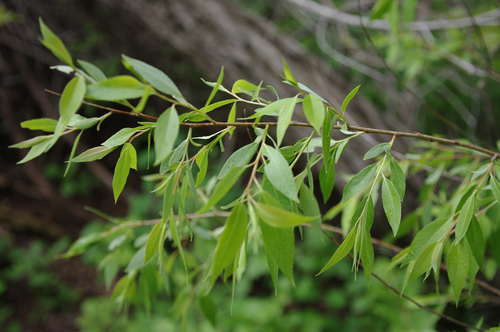
Salix amygdaloides, commonly called almond leaf willow or peach leaf willow, is a willow species native to central North America east of the Cascade Range. It occurs in southern Canada and the United States, ranging from western British Columbia to Quebec, and from Idaho, Montana and Arizona to eastern Kentucky. As of 2022, it is presumed extirpated from Kentucky. This species is a small to medium-sized deciduous tree that reaches 4–20 metres (13–66 ft) in height. Excluding cottonwoods, it is the largest tree native to the prairies. It typically grows with a single trunk, though it sometimes develops several shorter trunks. Its leaves are lanceolate, measuring 3–13 centimetres (1+1⁄4–5 in) long and 1–4 cm (1⁄2–1+1⁄2 in) wide. The leaves are yellowish green, with a pale, whitish underside and a finely serrated margin. Its flowers are yellow catkins 3–8 cm (1+1⁄4–3+1⁄4 in) long, produced in spring at the same time leaves emerge. The reddish-yellow fruit matures in late spring or early summer, and individual fruit capsules are 4–6 millimetres (3⁄16–1⁄4 in) long. Peachleaf willow grows very quickly, but is short-lived. It occurs on northern prairies, often growing near streams and alongside cottonwoods. As both the common and scientific names indicate, its leaves resemble leaves of peach trees, and bear an even closer resemblance to almond leaves.