About Salix alaxensis (Andersson) Coville
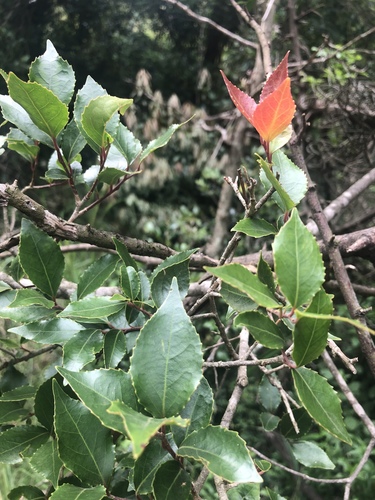
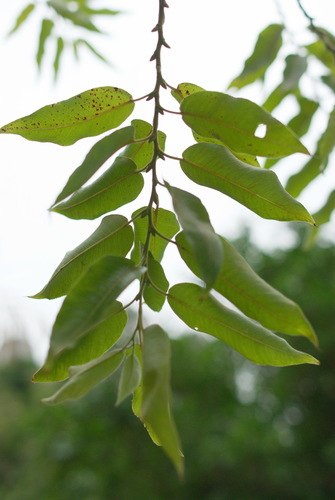
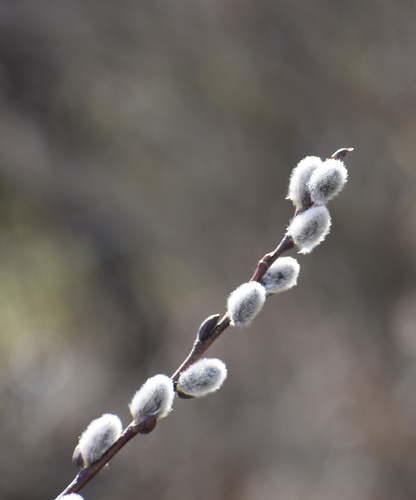
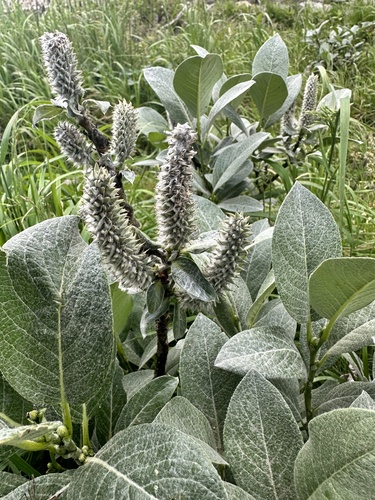
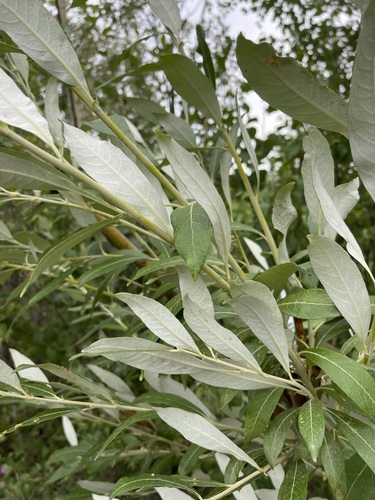
Salix alaxensis (Andersson) Coville, commonly known as Alaska willow, grows as a shrub or tree reaching up to 9 m (30 ft) tall, with a maximum stem diameter of 18 cm (7.1 in). Individuals growing in harsher climates stay much smaller. Its bark is smooth and gray when young, developing furrows and a scaly texture as it ages. Its leaves grow up to 11 cm long, with woolly textures on their undersides. Across its range, this willow is often a dominant species in willow communities, and co-occurring willow species in its habitat include Bebb willow (S. bebbiana), grayleaf willow (S. glauca), Sitka willow (S. sitchensis), Pacific willow (S. lasiandra), barren-ground willow (S. brachycarpa), and halberd willow (S. hastata). It grows along rivers, streams, and lakes, and can occur in forested regions, but it cannot tolerate shade, so it only persists in open areas. Thanks to its quick germination, it readily colonizes disturbed habitats, including recently flood-scoured riverbanks and areas where glaciers have receded. It grows during the early stages of ecological succession, and after a few decades, it is shaded out by poplars and other trees as the habitat matures into forest. This species is fire-adapted: it can resprout after its aboveground parts are burned, and its wind-dispersed seeds land on burned soil to colonize the new terrain. This species is dioecious, meaning male and female reproductive structures grow on separate individual plants. Its inflorescence is a catkin that grows up to 10 cm long, and its fruit is a capsule. Each seed has a downy fiber layer that lets it disperse via wind and moving water. Seeds stay viable for around one week, and germinate within 24 hours of being deposited on moist soil substrate. They do not germinate easily on dry soils or forest litter. The species primarily reproduces sexually through seed production, but it can also reproduce vegetatively. It resprouts easily, and broken stem fragments can often take root and grow into new individual plants. Moose particularly favor this plant, pulling down and breaking branches up to 4 cm in diameter and eating up to 90% of a plant's twigs. In some parts of northern Alaska, this species makes up 95% of moose's winter food. Snowshoe hares also prefer to feed on this willow. In northern Alaska, this plant may be the only available source of fuel wood, and it is one of the tallest willow species found on the Canadian Arctic Archipelago. Native Americans used parts of this willow species, along with other willows, for medicinal purposes, basket weaving, constructing bows and arrows, and building animal traps. Today, this plant is used for habitat restoration and revegetation of disturbed sites such as pipeline corridors. Cultivars have been developed, including the 'Rhode' cultivar, which has been used for revegetation projects. Cuttings and bundles of dormant branches can be planted directly in the ground and will take root successfully.