About Salicornia bigelovii Torr.
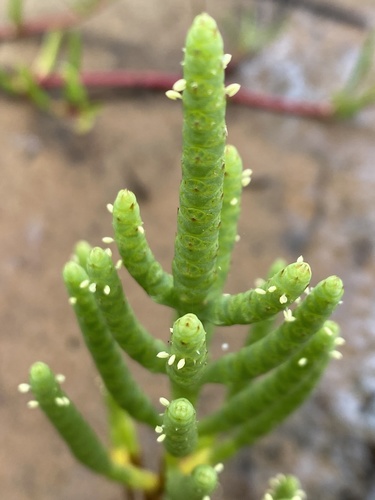
Salicornia bigelovii Torr. is a species of flowering plant in the family Amaranthaceae, commonly known as dwarf saltwort and dwarf glasswort. It is native to coastal areas of the eastern and southern United States, Belize, and both the east and west coasts of coastal Mexico. It grows in salt marshes, and is a halophyte that can grow in saltwater. This annual herb produces an erect, branching stem with many joints at its internodes. The fleshy stem, which ranges in color from green to red, can reach around 60 centimeters in height. Its leaves are typically small flat structures; pairs of leaves fuse into a band that wraps around the stem. The inflorescence is a dense, stick-shaped spike of flowers. Each flower has no petals, and consists of a fused pocket of sepals that encloses the stamens and stigmas. The fruit is an utricle that holds tiny, fuzzy seeds. In the southern part of the species' range, specifically in the Petenes mangroves of the Yucatán, it occurs as a subdominant associated plant in mangrove communities. This plant is receiving growing scientific attention for its potential as an oil crop that can be grown in desert environments and sustained with water that has high salt concentrations. It is the source of salicornia oil; the seeds of the plant contain up to 33% oil. The oil holds up to 79% linoleic acid, and functions similarly to safflower oil. It can be used as a cooking oil, and as a replacement for more valuable oils in chicken feed. The whole plant can also be used as forage for domestic animals. It may also serve as a source of biofuel. Salicornia bigelovii has numerous reported health benefits, and some of its bioactive metabolites have noted important pharmaceutical applications. Because this halophytic coastal species grows naturally in saltwater, it can be irrigated with seawater. This makes it a potential crop for landscapes that can support very few other crop species. It can also be watered with high-salt drainage water, such as the effluent from farmland in California's Central Valley. Commercial fields of this plant have already been grown using wastewater from aquaculture farms in Eritrea, and harvested to use as animal feed.