About Sagittarius serpentarius (J.F.Miller, 1779)
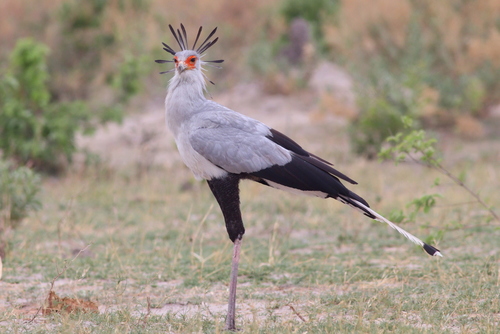
The secretarybird, Sagittarius serpentarius, is a very large terrestrial raptor that is instantly recognizable for its eagle-like head and body paired with crane-like legs. It stands around 1.3 m (4 ft 3 in) tall, with a total length of 1.1 to 1.5 m (3 ft 7 in to 4 ft 11 in), a wingspan of 1.9 to 2.1 m (6 ft 3 in to 6 ft 11 in), and a weight ranging from 3.74 to 4.27 kg (8.2 to 9.4 lb), with an average weight of 4.05 kg (8.9 lb). The tarsus averages 31 cm (12 in) and the tail measures 57–85 cm (22–33 in); these two traits make the secretarybird both taller and longer than any other raptor species. Its neck is not especially long, and can only be lowered to the intertarsal joint, so secretarybirds must stoop to reach the ground. In flight, two elongated central tail feathers extend past the feet, and the neck stretches out like a stork. The plumage of the crown, upperparts, and lesser and median wing coverts is blue-grey, while the underparts and underwing coverts are lighter grey to grey-white. A crest of long black feathers grows from the nape. The scapulars, primary and secondary flight feathers, rump, and thighs are black, and the uppertail coverts are white, though some individuals have black barring on these coverts. The wedge-shaped tail has a white tip, marbled grey and black colouring at the base, and two broad black bands, one at the base and one at the end. Male and female secretarybirds look similar to one another, though males typically have longer tail feathers, more head plumes, a shorter head, and bluer grey plumage. Adult secretarybirds have a featherless red-orange face, pale brown irises, and a yellow cere. Their legs and feet are pinkish-grey, and the upper legs are covered in black feathers. Their toes are short — around 20% of the length of the toes of an eagle of the same size — and stout, leaving the bird unable to grasp objects with its feet. The rear toe is small, and the three forward-facing toes are connected at the base by a small web. Immature secretarybirds have yellow (rather than orange) bare facial skin, more brownish plumage, shorter tail feathers, and grey (rather than brown) irises. Adults are normally silent, but can produce a deep guttural croaking noise during nuptial displays, at nests, when greeting mates, during threat displays, or when fighting other birds; sometimes they throw their head backwards while making this call. When alarmed, they may give out a high-pitched croak. Mated pairs at the nest make soft clucking or whistling calls. For their first 30 days, chicks produce a sharp sound described as "chee-uk-chee-uk-chee-uk". The secretarybird is endemic to sub-Saharan Africa and is generally nonmigratory, though it may be locally nomadic as it follows rainfall and the resulting increase in prey availability. Its range stretches from Senegal to Somalia, and south to the Western Cape, South Africa. It occurs across a variety of elevations, from coastal plains to highlands. It prefers open grasslands, savannas, and Karoo shrubland over forests and dense shrubbery, which would interfere with its ground-dwelling lifestyle. Specifically, it prefers areas with grass under 0.5 m (1 ft 8 in) tall, and avoids areas with grass over 1 m (3 ft 3 in) tall. It is rarer in otherwise similar grasslands in the northern part of its range than it is in the abundant southern populations, suggesting it may avoid hotter regions. It also avoids deserts. Secretarybirds are not generally gregarious, aside from pairs and their offspring. They usually roost in trees of the genus Acacia or Balanites, and even in introduced pine trees in South Africa. They leave the roost 1–2 hours after dawn, generally after spending time preening. Mated pairs roost together, but may forage separately, though often stay within sight of each other. They pace at a speed of 2.5–3.0 km/h (1.6–1.9 mph), taking an average of 120 steps per minute. After spending most of the day on the ground, secretarybirds return to roost at dusk, moving downwind before flying upwind. Single birds are often unattached males, whose territories are generally in less suitable habitat. In contrast, larger groups of up to 50 individuals may gather in areas with concentrated local resources, such as a waterhole in a dry region, or an irruption of rodents or locusts fleeing a fire. Secretarybirds soar with their primary feathers splayed to manage turbulence. They can flap their wings, but this movement is slow and laborious, and requires uplift to sustain; without uplift, they can become exhausted. During midday heat, they use thermals to climb up to 3,800 m (12,500 ft) above the ground. The average lifespan is thought to be 10 to 15 years in the wild and up to 19 years in captivity. The oldest confirmed wild secretarybird was a 5-year-old that was banded as a nestling on 23 July 2011 in Bloemfontein and recovered 440 km (270 mi) away in Mpumalanga on 7 June 2016. Like all birds, secretarybirds host haematozoan blood parasites including Leucocytozoon beaurepairei, recorded from Mozambique in 1954. Wild birds from Tanzania have been found to carry Hepatozoon ellisgreineri, a haematozoan genus unique for maturing within granulocytes, mainly neutrophils. Ectoparasites of secretarybirds include the lice Neocolpocephalum cucullare (Giebel) and Falcolipeurus secretarius (Giebel). Unlike most birds of prey, the secretarybird is largely terrestrial and hunts its prey on foot. Adults hunt in pairs and sometimes as loose familial flocks, stalking through habitat with long strides. Prey can include insects such as locusts, other grasshoppers, wasps, and beetles, as well as millipedes, spiders, scorpions, and freshwater crabs, but small vertebrates usually make up most of their prey biomass. Known prey includes rodents, frogs, lizards, small tortoises, eggs, and birds such as warblers, larks, doves, small hornbills, and domestic chickens. They occasionally prey on larger mammals such as hedgehogs, mongooses, small felids like cheetah cubs, striped polecats, young gazelles, and both young and full-grown hares. The role of snakes in the secretarybird's diet was exaggerated in the past, though snakes can be locally important, and venomous species such as adders and cobras are regularly preyed upon. Secretarybirds do not eat carrion, though they occasionally consume dead animals killed by grass or bushfires. Secretarybirds often flush prey from tall grass by stomping on the surrounding vegetation. They may raise their crest feathers during a hunt, which may help scare prey and provide shade for the face. A secretarybird will chase prey with its wings spread, and kill by delivering swift striking blows with its feet. Only small prey such as wasps are picked directly with the bill. There are unverified reports that secretarybirds fly with captured snakes and drop them to kill them. Even with larger prey, food is usually swallowed whole through the bird's considerable gape. Occasionally, like other raptors, they will hold down food with their feet while tearing it apart with the bill. Indigestible food is regurgitated as pellets 40–45 mm (1.6–1.8 in) in diameter and 30–100 mm (1.2–3.9 in) in length, which are dropped on the ground usually near roost or nest trees. Compared to large African birds with more mixed diets, such as the kori bustard, the secretarybird has a relatively short digestive tract. Its foregut is specialized for consuming large amounts of meat with little need for mechanical food breakdown. Like other carnivorous birds, it has a dilated crop and a non-muscular gizzard. The large intestine has a pair of vestigial ceca, as fermentative digestion of plant material is not required. Secretarybirds specialize in stomping prey until it is killed or immobilized, a hunting method commonly used on lizards or snakes. When an adult male trained to strike at a rubber snake on a force plate was tested, it struck with a force equal to five times its own body weight, with a contact period of only 10–15 milliseconds. This short contact time suggests the secretarybird depends on superior visual targeting to find the exact location of the prey's head. While little is known about its visual field, it is assumed to be large, frontal, and binocular. Secretarybirds have unusually long legs (nearly twice as long as other ground birds of the same body mass), which is thought to be an adaptation for their unique stomping and striking hunting method. However, these long limbs also appear to lower their running efficiency. Ecophysiologist Steve Portugal and colleagues have hypothesized that the extinct Phorusrhacidae (terror birds) may have used a hunting technique similar to that of secretarybirds, due to anatomical similarity, even though the two groups are not closely related. Secretarybirds rarely encounter other predators, with the exception of tawny eagles, which steal their kills. Tawny eagles mainly steal larger prey and attack secretarybirds both singly and in pairs. Secretarybird pairs are sometimes successful at driving the eagles away, and may even knock them down and pin them to the ground.

