About Sagittaria sagittifolia L.
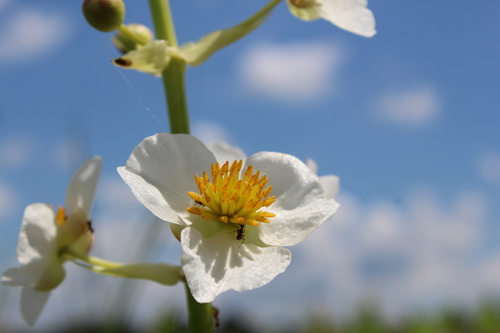
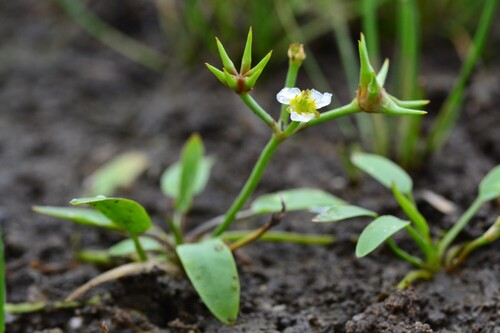
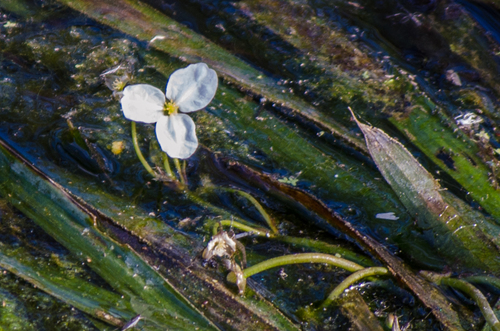
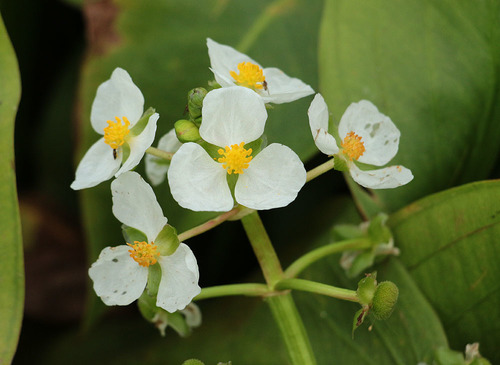
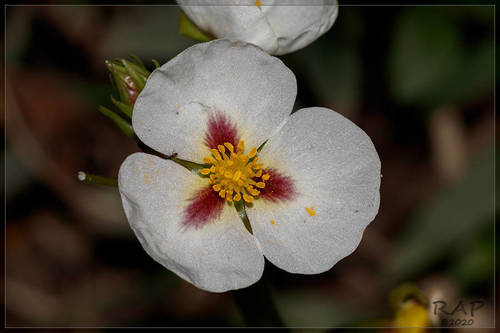
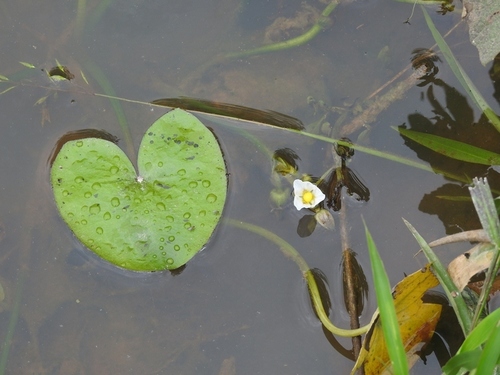
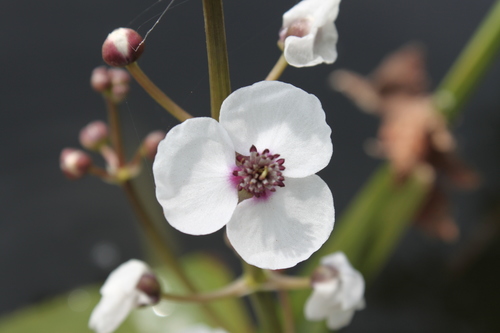
Sagittaria sagittifolia L. is a herbaceous perennial aquatic plant that grows in water 10–50 centimetres (4–19+1⁄2 inches) deep. It produces two types of leaves: emergent leaves growing above the water surface are arrowhead-shaped, with blades 15–25 cm (6–10 in) long and 10–22 cm (4–8+1⁄2 in) wide, borne on long petioles that hold the leaves up to 45 cm (17+1⁄2 in) above water. The plant also has narrow, linear submerged leaves that can reach up to 80 cm (31+1⁄2 in) long and 2 cm broad. Its flowers are arranged in panicles; each flower is 2–2.5 cm wide, with three small sepals, three white petals, and numerous purple stamens. This species is native to wetlands across most of Europe, where it is extinct in Spain. Its native range also extends across Asia, including Finland, Bulgaria, Russia, Ukraine, Siberia, Turkey, and the Caucasus. In Britain, it is the only native species in the Sagittaria genus. It is also cultivated as a food crop in some other countries outside its native range. According to the USDA Animal and Plant Health Inspection Service, Plant Protection and Quarantine, S. sagittifolia can be weedy or invasive, and it appears on state noxious weed lists for 46 U.S. states. The plant produces round edible tubers: these tubers are starchy, have a bland flavour, and have a texture similar to potato but are somewhat crunchier even after cooking. In Japan, this species is called kuwai クワイ (慈姑), and its tubers are traditionally eaten especially during the New Year. In China, it is called 慈姑 cígū, and is commonly used in winter hot pots. In Vietnam, the young petioles, leaves, and rhizomes of the plant are used to make soups. Remnants of Sagittaria sagittifolia have been recovered from the Paleolithic/Mesolithic archaeological site of Całowanie in Poland. S. sagittifolia is used in traditional Chinese medicine. In 2006, seven new ent-rosane diterpenoids and one new labdane diterpene were purified from this plant. Four of these isolated compounds, named Sagittine A–D, showed antibacterial activity against Streptococcus mutans and Actinomyces naeslundii. A fifth compound, Sagittine E, only showed activity against A. naeslundii, with a minimum inhibitory concentration (MIC) of 62.5 μg ml–1. The same research group later identified five new diterpenoids from Sagittaria pygmaea. None of these compounds from S. pygmaea showed activity against Aggregatibacter actinomycetemcomitans; four were active against Actinomyces viscosus, three were active against S. mutans, and 18-ß-D-3',6'-diacetoxyglucopyranosyl-ent-kaur-16-ene was the most active among these.