About Saga pedo (Pallas, 1771)
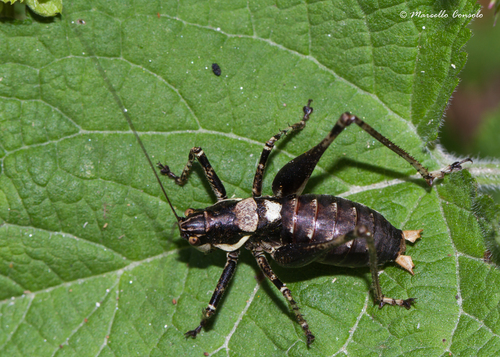
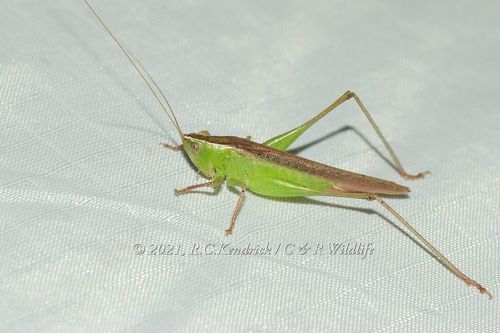
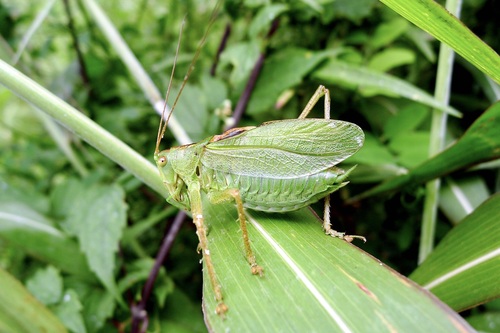
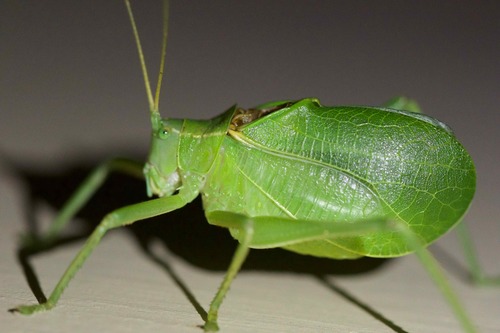
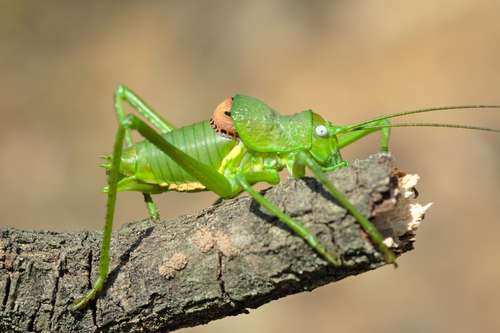
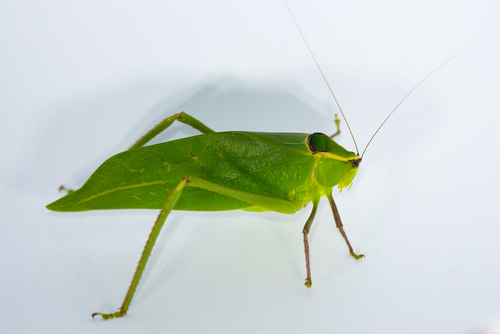
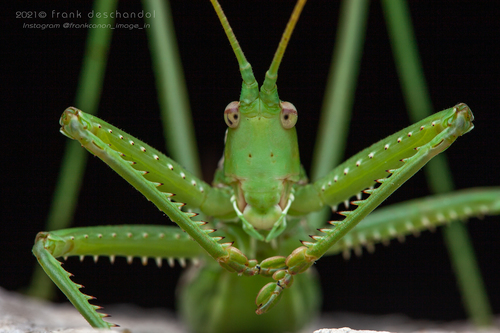
Saga pedo is a wingless bush cricket species found in the southern half of Europe, and western and central Asia. This brown or green bush cricket typically has a total length measured from the head to the tip of the ovipositor of up to 10.5 cm (4.1 in), and may exceptionally reach 12 cm (4.7 in). This size makes it one of the largest European insects, and one of the world's largest Orthoptera, the group that includes grasshoppers, crickets, and related insects. For adult individuals, the head-and-body length alone is typically 5–7 cm (2.0–2.8 in), and can reach up to 7.8 cm (3.1 in). It is known colloquially as the predatory bush cricket, or the spiked magician – this second name comes from the "enchanting" way it waves its forelimbs when approaching prey. It is an unusual species because it has a strictly carnivorous lifestyle, and uses parthenogenetic reproduction: only females exist, and they breed on their own. Saga pedo is distributed across the southern half of Europe, and through western and central Asia as far east as northwestern China (Xinjiang) and southwestern Siberia. In Asia, the southernmost edge of its distribution reaches southern Anatolia, Armenia, Azerbaijan, Tajikistan, and Turkmenistan, while it ranges north as far as Kurgan Oblast, Russia, at latitude 54º30' N. In Europe, the southernmost locations where it occurs are Italy (including Sardinia and Sicily), far northern Greece, and the Iberian Peninsula, where it is widespread but local in Spain, and its presence in Portugal is questionable. In Europe outside of Russia, it occurs as far north as the Czech Republic, Slovakia, and Ukraine. Further west, its range does not extend north of the Alpine region: it is found in both Austria and Switzerland, but not in Germany. In France (including Corsica), it is restricted to southern regions up to approximately 200 km (120 mi) from the Mediterranean coast. This makes Saga pedo the Saga species with by far the largest distribution, and the species that ranges farthest to the north, farthest to the west, and farthest to the east. All other Saga species are restricted to the southern and eastern Balkans, Greek islands, and Southwest Asia. Saga pedo generally prefers areas with dry summers and mild winters. It can be found in habitats from sea level up to an altitude of 1,750 m (5,740 ft), and may occur in grasslands, meadows, pastures, shrubland, thickets, plains, forest steppes, semi-open areas along forest edges, gorges, hedges, grain fields, and vineyards. A few weeks after reaching maturity, the female begins laying eggs, and will continue laying for the rest of her adult life, which can last up to half a year. The female has a pointed ovipositor that is typically about 3–4 cm (1.2–1.6 in) long, which is slightly more than half of her head-and-body length. She inserts this ovipositor into soil at a suitable site to deposit her eggs. The eggs of Saga pedo are among the largest known for any insect, reaching up to about 12 mm (0.47 in) long and 4 mm (0.16 in) wide. A female will lay between twenty-five and eighty eggs. Egg development depends largely on ambient temperature. At 20 °C (68 °F) or warmer, eggs start developing immediately, and nymphs hatch after approximately 40 to 85 days, with the exact time depending on temperature. In colder conditions, eggs enter diapause, a state of delayed development that can leave eggs buried for up to five years, with most remaining buried for two to three years. Hatching does not occur earlier than April. After hatching, nymphs go through five to seven instars before reaching sexual maturity. In the first couple of instars, the ovipositor is very small, shorter than the cerci, and barely noticeable. In older instars, meaning older immature individuals, the ovipositor is already quite long and obvious.