About Sabatia angularis (L.) Pursh
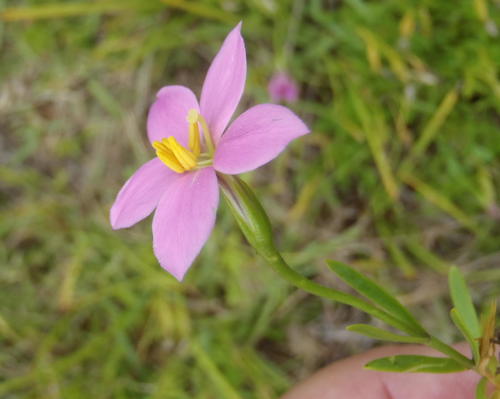
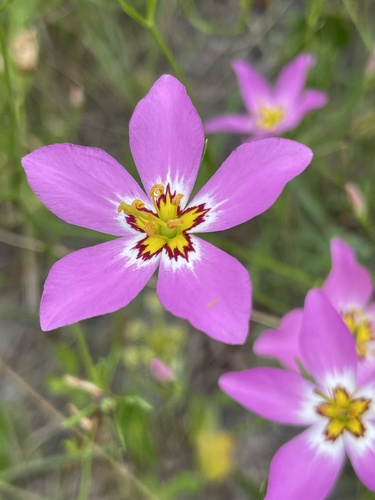
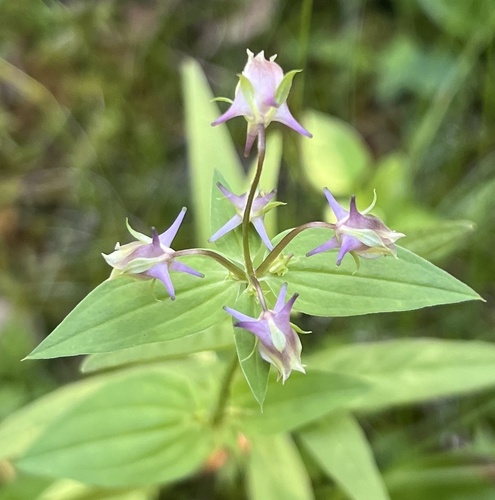
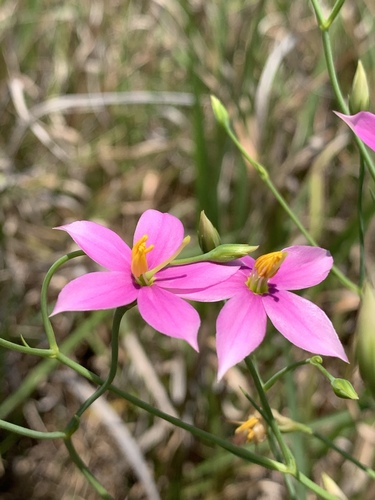
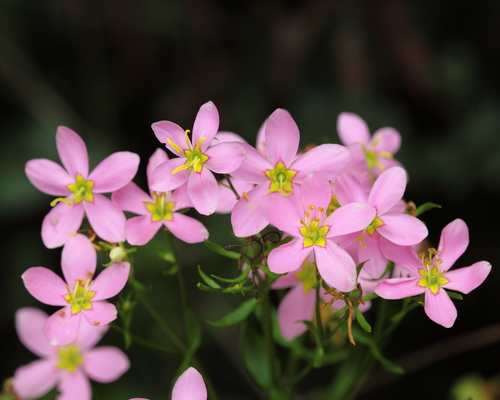
Sabatia angularis (L.) Pursh is a biennial plant that reaches a mature height of 0.8–0.9 metres (2.5–3 ft). In its first year of growth, it only forms a low rosette of leaves at its base. In the second year, one or more stems grow upward from the basal leaves. These stems have a 4-sided square cross-section, are hairless (glabrous), and have thin, flexible wings along their edges. The lower section of the main stem is unbranched, while most branches grow from leaf nodes in the upper portion of the stem. The leaves of Sabatia angularis are arranged opposite one another, are simple and smooth-edged (without teeth), glabrous, shaped ovate to ovate-lanceolate, and grow up to about 3.8 centimetres (1.5 in) long and 2.5 centimetres (1 in) wide. This plant blooms from June to September, producing fragrant flowers up to 2.5 centimetres (1 in) across that are most often pink, and occasionally white. Each flower has 5 petal-like obovate lobes, with yellowish triangular markings on the inner edge of the lobes that create the appearance of a star at the flower’s center. After flowers fade, the plant produces seed capsules that hold many tiny seeds. Seeds are dispersed by wind, and the plant is capable of self-seeding. Sabatia angularis is geographically widespread across the United States: in the southern U.S. it ranges from Arizona in the west to the east coast, and in the northern U.S. it ranges from Illinois in the west to Massachusetts in the east. It is native to Ontario, Canada, but it is thought to be extirpated there. It grows in a variety of habitats, including glades, roadsides, fields, and the margins of woods.