About Sabal palmetto (Walter) Lodd. ex Schult. & Schult.f.
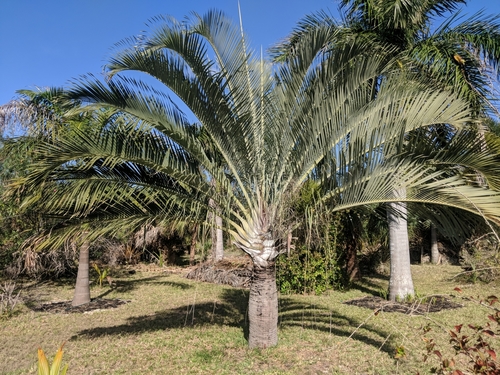
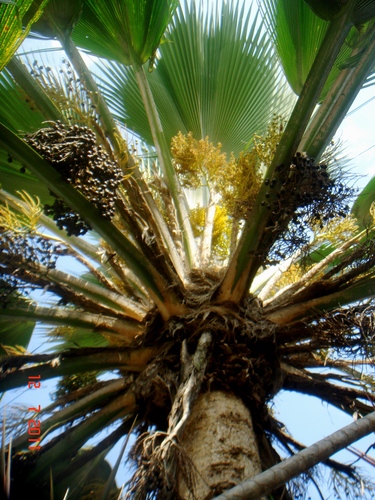
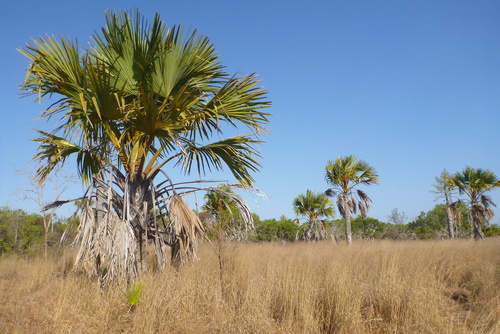
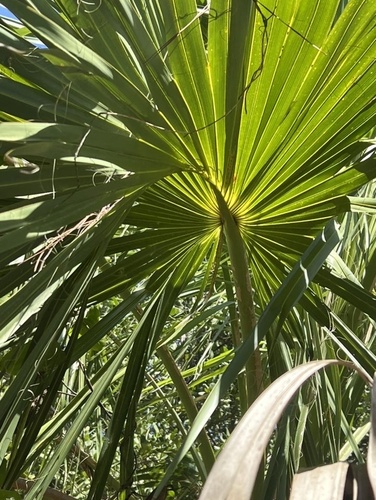
Sabal palmetto (Walter) Lodd. ex Schult. & Schult.f., commonly called cabbage palm or cabbage palmetto, can grow up to 24 m (80 ft) tall; the tallest recorded individual measures 93 feet. Starting at half to two-thirds of its total height, the tree produces a rounded, costapalmate fan made up of numerous leaflets. A costapalmate leaf has a distinct central costa (midrib), which sets it apart from a typical palmate (fan) leaf, but its leaflets are arranged radially just like in a palmate leaf. All costapalmate leaves measure about 5 mm (1⁄4 in) across. This palm produces large compound panicles up to 2.5 m (8 ft) in radius that extend out beyond the leaves. Its fruit is a black drupe around 1.3 cm (1⁄2 in) long that holds a single seed. It is extremely salt-tolerant, and is often found growing on the coastal plain and along the coasts of the Atlantic Ocean and Gulf of Mexico.
Sabal palmetto is native to subtropical coastal regions of the U.S. states of Florida, Georgia, South Carolina, southeastern North Carolina, and extreme southern Texas. It is also cultivated in other areas of the Southeastern U.S., including parts of southeastern Virginia, southwestern Alabama, and southeastern Mississippi. It can also be found along Cuba’s northern coast from Havana to Matanzas, in the Turks and Caicos Islands, on Mexico’s Yucatán Peninsula, and in the Bahamas. The species is hardy to U.S. Department of Agriculture zone 8a, and has been reported to tolerate cold temperatures as low as 8.6 °F (−13.0 °C), but requires hot, humid summers to grow well. Cabbage palm is very low-maintenance and highly adaptable. It tolerates drought, standing water, and brackish water. While it is drought-tolerant, it thrives with regular light watering and regular feeding. It is highly tolerant of salt winds, but does not tolerate saltwater flooding.
Sabal palmetto is a popular landscape plant in the subtropical climates of the Gulf and south Atlantic states, primarily from coastal North Carolina to Florida. It is used extensively around beaches and resort areas along the lower East Coast, due to its tolerance for salt spray and drought. Because of its relatively long establishment period and prevalence on southern ranchlands, few if any specimens are grown from seed in nurseries. Instead, established wild plants are dug with small rootballs, since nearly all severed roots die and must be replaced by new roots after transplanting to a new location. Most leaves are removed during transplanting to reduce transpiration. Cabbage palms have excellent hurricane resistance, but are frequently overpruned in the mistaken belief that this lowers wind load. Sabal palmetto seed germination performs best in hot, humid summer climates. Most sources rate the species as hardy to USDA hardiness zone 8b. A small number of specimens are cultivated outside its typical cultivation range, including parts of Tennessee, northern Virginia, and along the middle Atlantic coast from Maryland to coastal New Jersey and coastal Connecticut. A long-term specimen, covered with frost cloth in winter, has grown in a favorable microclimate (zone 7a/b) at the University of Bridgeport, Connecticut since 2009. The cabbage palm is remarkably resistant to fire, floods, coastal conditions, cold, high winds, and drought. Despite this, mortality can be caused by Texas phoenix palm decline (now known as Lethal Bronzing Disease), a phytoplasma first found on the west coast of Florida in 2006.
Sabal palmetto trunks occur in two distinct forms, which can be confusing. When leaves die, their leaf bases typically persist for some time, creating a spiky "basketweave" effect. These remaining leaf bases are called "bootjacks" or "boots" for short. The name comes from their Y shape, which resembles devices once used to help people remove boots. Transplanted palms are sometimes intentionally trimmed of these bootjacks. Taller specimens are more likely to have lost their bootjacks, giving them a relatively smooth, columnar trunk. The loss of bootjacks is a natural, poorly understood phenomenon; since the palm does not grow a leaf abscission zone, leaf base loss occurs through a different physical or biological process. In 1998, a new mutant form of S. palmetto was discovered in southwest Florida, and released as the cultivar Sabal palmetto 'Lisa'. This cultivar has unusually thick, leathery, largely fused leaflets that give the palm a unique, attractive appearance. Over 60% of seedlings grown from this cultivar inherit the same leaf characteristics as the parent plant. Sabal palmetto 'Lisa' has become popular in the Florida nursery trade over the past 20 years, and has proven to be just as resistant to heat, wind, cold, drought, and neglect as the common form, while retaining its distinct shape.
The growing heart of new fronds, also called the terminal bud, gives the tree its "cabbage" common name. This bud is extracted as food, and tastes like other undifferentiated plant meristem tissue, such as the heart of a cabbage or artichoke. It is one of several palm species sometimes used to make heart of palm salad. Heart of palm was commonly eaten by Native Americans. However, extracting the terminal bud kills this palm species, because the terminal bud is the only point from which the palm can grow; without this bud, the palm cannot replace old leaves and eventually dies. The bristles on the sheaths of young leaves have been made into scrubbing brushes. The trunks have been used as wharf piles. On June 28, 1776, Charleston patriots led by William Moultrie built a fort from palmetto trunks and successfully defended against the British in the American Revolutionary War. The fruit is edible raw, and the seeds can be ground into flour.