About Sabal minor (Jacq.) Pers.
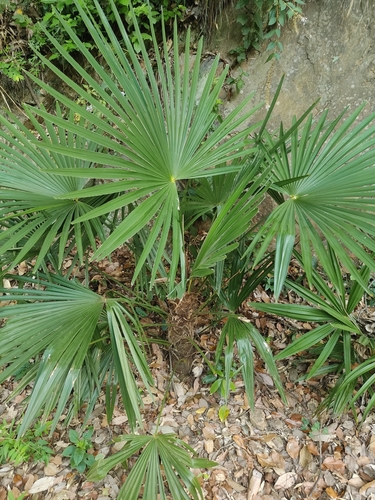
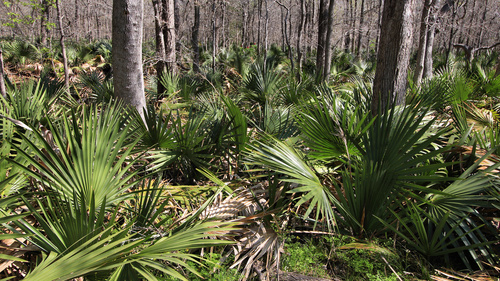
Sabal minor (Jacq.) Pers. is a fan palm in the Arecaceae family, tribe Corypheae. It typically reaches up to 3 meters (9.8 ft) in height, with a trunk that grows up to 30 centimeters (12 in) in diameter. While it is usually small and shrubby when young, it can develop a tree-like form as it ages. Its leaves have bare petioles that end in a rounded fan of numerous leaflets; each entire leaf is 1.5–2 m (4 ft 11 in – 6 ft 7 in) long, and holds up to 40 leaflets that each measure up to 80 cm (31 in) long, with the leaflets joined together for more than half their length. The species produces yellowish-white flowers that are 5 millimeters (0.20 in) across. These flowers grow in large compound panicles up to 2 m (6 ft 7 in) long, that extend out beyond the plant's leaves. The fruit is a black drupe 1 to 1.3 cm (0.4 to 0.5 in) long that contains a single seed. The native range of Sabal minor extends along the Atlantic Coast from central Florida north to Monkey Island, North Carolina. Along the Gulf Coast, its native range spans from central Florida to central Texas and Arkansas, north to southern Oklahoma and northern Alabama, and south into the Mexican state of Nuevo León. Sabal minor is one of the most cold-hardy palms available in cultivation. It grows best in continental climates with hot, humid tropical summers, and may struggle or grow slowly in cool summer oceanic climates. Established plants are hardy to around −15 °C (5 °F), and selected cultivated varieties can be hardy to −20 °C (−4 °F) once established. It is generally cultivated in subtropical and warm temperate climates. It can grow in a wide variety of soil types, and is naturally found growing submerged in swamps in the southeastern United States. It tolerates both full sun and shaded locations, but grows best in full sun and a wind-sheltered spot in cooler garden zones (below USDA Zone 7). In the United States, cultivation of Sabal minor has spread beyond the deep southern United States since the 1960s. It is now cultivated along the East Coast from Florida to Connecticut, and on the West Coast from Vancouver, British Columbia, south to San Diego, California. It is listed as a recommended horticultural plant by the Virginia Cooperative Extension. Several cultivars exist, including strains native to the Outer Banks of North Carolina (the northernmost naturally occurring strains), as well as strains from Oklahoma and Texas. One popular cultivar is 'McCurtain', named for McCurtain County, Oklahoma, where the original strain is native. These northern and inland strains tend to stay trunkless and smaller than Sabal minor from warmer regions. Sabal minor is a popular landscape palm in coastal resort areas from Virginia Beach, Virginia, to southern Texas.