About Russula roseopileata McNabb
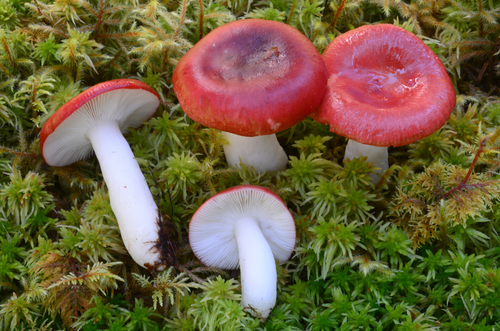
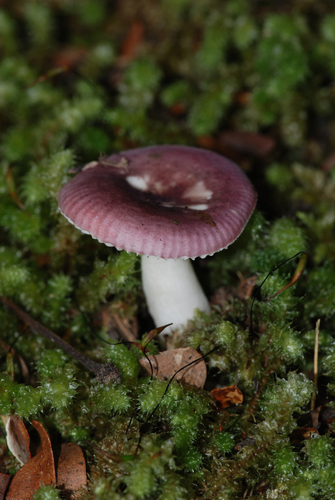
Russula roseopileata McNabb produces typical mushroom-shaped fruiting bodies. The cap (pileus) has a diameter of 1.5–4.5 cm. Young immature caps are hemispherical, and become centrally depressed as they mature. When wet, the cap surface is smooth (glabrous). Cap color is variable: the center is red to dark red, fading to greyish rose, rose, or pink at the edges; occasionally it may be creamy to pallid white, with pink, rose, purplish grey, or yellow tints. The gills (lamellae) are thin, sometimes forked near the stem (stipe), and stay white throughout development. The stipe grows up to 4 cm long, occasionally widens at the base, is usually 0.5–1.2 cm in diameter, and remains white after exposure to air. Both the gills and internal flesh (context) have an extremely acrid taste. Standard chemical spot tests produce the following results: formalin causes no reaction on the context; phenol slowly turns deep vinaceous; FeSO4 (iron(II) sulfate) rapidly turns salmon pink; guaiacol applied to the stipe base slowly turns pinkish red; KOH (potassium hydroxide) applied to red areas of the pileus fades the red, leaving the tested area orange; KOH causes no reaction on the context; NH4OH (ammonium hydroxide) causes no reaction on either the pileus or the context. This species commonly grows in groups (gregarious) under Nothofagus trees. It is native and endemic to New Zealand. Documented collections were made by Ross McNabb in the Nelson region and along Lake Daniells Track in the Lewis Pass Region, on New Zealand's South Island West Coast.