About Russula mustelina Fr.
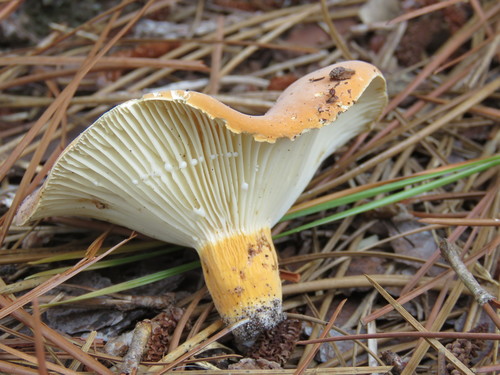
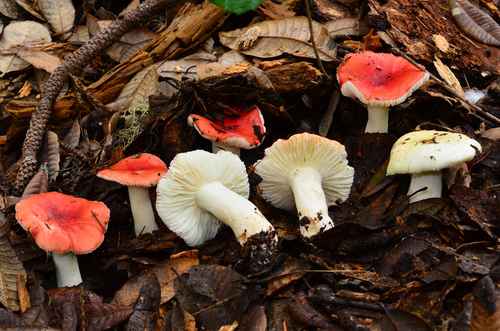
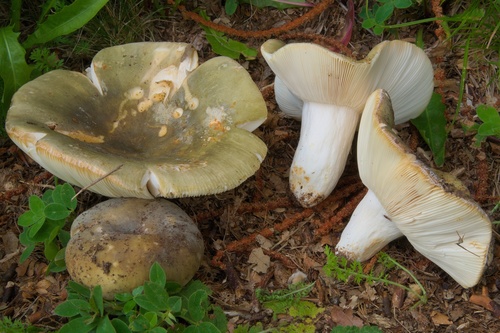
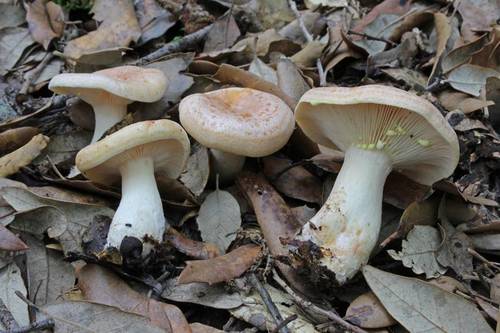
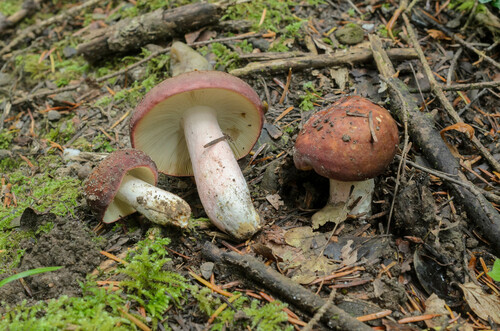
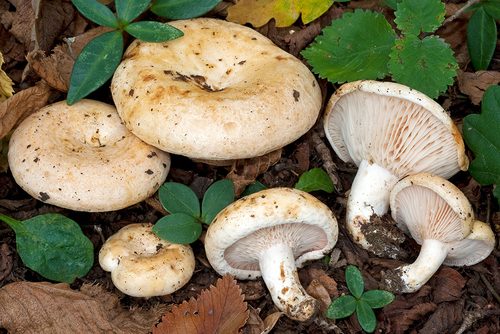
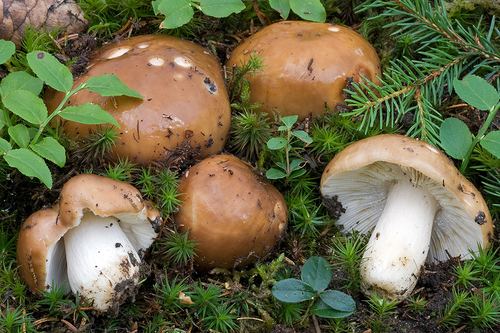
The fruit bodies of Russula mustelina Fr. appear in autumn, and may be partly submerged in soil. The cap is 7–12 cm (2.8–4.7 in) wide, occasionally growing up to 16 cm (6.3 in). Young specimens have convex caps that flatten with age, and mature caps sometimes develop a shallow central depression. The cap surface is dry, and becomes slightly sticky when wet. Its color ranges from pale yellow to yellow-brown, with a wine-colored margin; older caps often develop discolored wine-colored splotches. The white flesh is 3–10 mm (0.1–0.4 in) thick under the cap, and has a mild taste. The cream-colored gills attach to the stem in a range from adnate to adnexed. Fruit bodies have almost no detectable odor. The hard, white stem measures 4–9 cm (1.6–3.5 in) long by 2–3 cm (0.8–1.2 in) thick. It is roughly uniform in width along its length, though it may be slightly thicker near the base, and has a dry, smooth surface. Russula mustelina produces a yellowish spore print. Its spores are roundish, measure 7.5–10.5 by 6.5–9 μm, and have a reticulate (web-like), ridged surface with occasional warts. The similar species Russula basifurcata produces smaller fruit bodies, associates with oak trees at lower altitudes, and has gills that fork near the stem. In terms of ecology, Russula mustelina grows in coniferous forests above 1,600 m (5,200 ft) in the Sierra Nevada and Cascade Range of western North America. It is found in rare peat bog habitat in the eastern Carpathians of Romania, where it associates with European spruce (Picea abies). It also grows in the Ivory Coast, where local people pick and eat it.