About Russula emetica (Schaeff.) Pers.
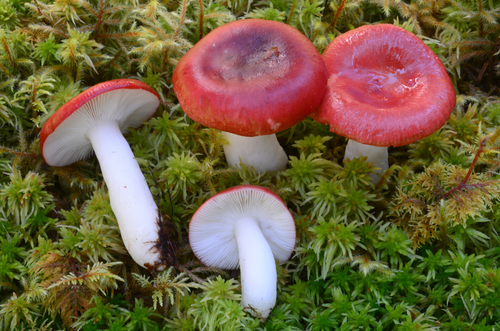
Russula emetica (Schaeff.) Pers. has a sticky cap 2.5–10 cm (1–4 in) wide. Young specimens have convex caps that flatten with age; caps sometimes develop a central depression, and occasionally have a shallow umbo. The cap is bright scarlet or cherry red, and mature specimens have fine radial grooves along the margin that extend 2–7 mm (0.08–0.3 in) toward the cap center. The cap cuticle can be easily peeled almost all the way to the center. The flesh is brittle, white (or tinted red directly under the cap cuticle), 4–9 mm (0.2–0.4 in) thick, and has a very sharp, peppery taste. The gills are closely spaced, white to creamy-white, and range from adnate to adnexed or completely free. They are intervenose, meaning cross-veins are present in the spaces between gills, and are occasionally forked near the cap margin. The white stem is 4.5–10.5 cm (1.8–4.1 in) long by 0.7–2.4 cm (0.3–0.9 in) thick, and is roughly uniform in width along its length, though it may be slightly thicker near the base. Its surface is dry and smooth, and sometimes marked with faint longitudinal grooves. The stem is either stuffed with cottony pith or partially hollow, and has no ring or partial veil. Fruit bodies have a slightly fruity or spicy odor. This species produces a white to yellowish-white spore print. Its spores are roughly elliptical to egg-shaped, with a strongly warted, partially reticulate (web-like) surface. They measure 8.8–11.0 by 6.6–8 μm, and are amyloid, meaning they stain blue, bluish-grey, or blackish in Melzer's reagent. The spore-bearing basidia are club-shaped, four-spored, hyaline (translucent), and measure 32.9–50 by 9.0–11.6 μm. Cystidia on the gill face (pleurocystidia) are somewhat cylindrical to club-shaped or somewhat spindle-shaped, measure 35–88 by 7.3–12.4 μm, are yellowish, and contain granular contents. Cheilocystidia, found on the edges of the gills, have a similar shape to pleurocystidia; they are thin-walled, hyaline, and measure 14–24 by 4.4–7.3 μm. Clamp connections are absent from the hyphae. The red pigments of R. emetica and other russulas are somewhat water-soluble, and fruit bodies often bleach or fade when exposed to rain or sunlight. Older specimens may have cap color that fades to pink or orange, or develops white blotches. Russularhodin is the main pigment responsible for the red color of the fruit bodies, though little is known about its chemical composition. Like all Russula species, R. emetica is mycorrhizal, forming mutually beneficial partnerships with the roots of trees and certain herbaceous plants. It prefers conifer host plants, especially pines. Fruit bodies grow singly, scattered, or in groups in sphagnum moss near bogs, and in coniferous and mixed forests. The fungus occasionally grows on humus or very rotten wood. It is distributed across North Africa, Asia and Europe, and can be locally very common. The extent of its range in North America is uncertain, because some historical sightings actually refer to the related species R. silvicola; early on, the name Russula emetica was often applied to any red-capped white Russula. Reports of the species from Australia now refer to the similarly colored R. persanguinea. A multi-year field study of R. emetica growth in a Scots pine plantation in Scotland found total productivity was 0.24–0.49 million mushrooms per hectare per year (roughly 0.1–0.2 million mushrooms/acre/year), corresponding to a fresh weight of 265–460 kg per hectare per year (49–85 lb/acre/year). Productivity is highest from August to October, and individual mushroom longevity is estimated at 4–7 days. In a study of ectomycorrhizal fungal diversity in a Sitka spruce forest, R. emetica was one of the five dominant fungi. When comparing fruit body production frequency across 10-, 20-, 30-, and 40-year-old forest stands, R. emetica was most prolific in 40-year-old stands. It fruits from late summer until early winter. Both the Eurasian red squirrel (Sciurus vulgaris) and the American red squirrel (Tamiasciurus hudsonicus) forage for, store, and eat R. emetica. Other documented consumers of the mushroom include the snail Mesodon thyroidus, several slug species (Arion ater, A. subfuscus, A. intermedius, Limax maximus, L. cinereoniger, and Deroceras reticulatum), the fruit flies Drosophila falleni and D. quinaria, and the fungus gnat Allodia bipexa. As its common name the sickener implies, R. emetica is inedible, though it is not as dangerous as older mushroom guides sometimes described it. Ingestion mainly causes gastrointestinal symptoms: nausea, diarrhoea, vomiting, and colicky abdominal cramps. Symptoms typically begin half an hour to three hours after eating the mushroom, and usually subside on their own or shortly after the ingested material is expelled from the intestinal tract. The active toxic compounds have not been definitively identified, but are thought to be sesquiterpenes, a class of compounds that have been isolated from the related genus Lactarius and from Russula sardonia. Sesquiterpenoids identified in R. emetica include the previously known compounds lactarorufin A, furandiol, methoxyfuranalcohol, plus an unnamed compound unique to this species. The mushroom's bitter taste disappears when cooked, and it is said to be edible after this process, though consumption is not recommended. It was once widely eaten in eastern European countries and Russia after parboiling to remove toxins, followed by salting or pickling. In some regions of Hungary and Slovakia, the cap cuticle is removed and used as a spice for goulash.