About Russula cyanoxantha (Schaeff.) Fr.
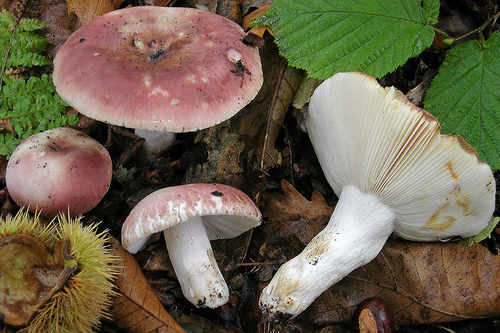
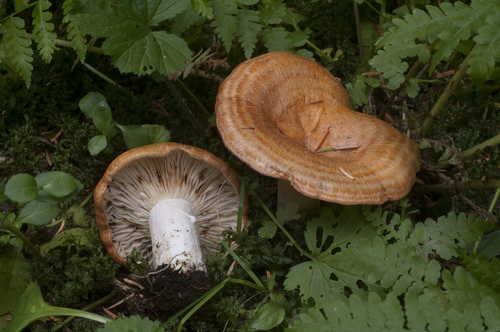
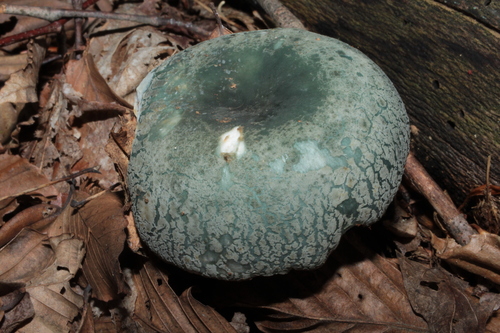
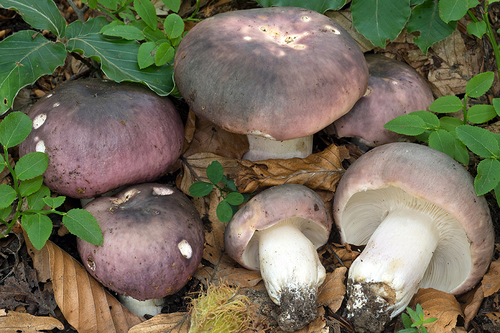
This species has the most prominent characteristic of weak gills that feel greasy to the touch, are flexible, and do not break. The cap is 4–18 cm (1+1⁄2–7 in) wide; it is convex when young and becomes flattened later, and ranges in color from greenish to bright brown, with considerable color variation. The gills are white to cream, are sometimes forked, and are not as brittle as the gills of most other members of the genus Russula. The stipe is pure white, slightly convex on its lower portion, measures 2.5–12 cm (1–4+3⁄4 in) in height and 1–5 cm (1⁄2–2 in) in diameter. Both the spores and the spore print are white. The stipe does not develop a salmon color reaction when rubbed with ferrous sulphate. Russula cyanoxantha grows in slightly acidic, nutrient-rich soil. Like all Russulas, it is a mycorrhizal fungus. It is most commonly found in beech forests, and also often grows in deciduous or mixed forests. It is possible that only European specimens represent true R. cyanoxantha. In eastern North America and the Mountain states, it appears from July to October; in areas further west, it appears from October to January. This is an edible mushroom suitable for many types of preparation. Its flesh is not as hard as the flesh of many other edible Russulas. It has a mild, nutty taste, but maggots also commonly infest it.