About Russula caerulea Fr.
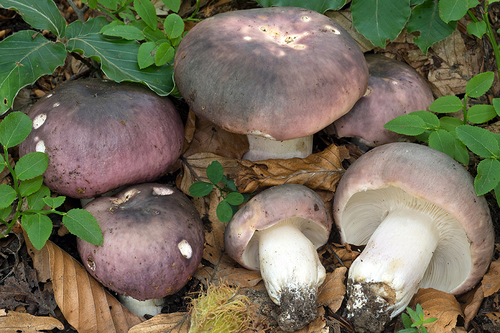
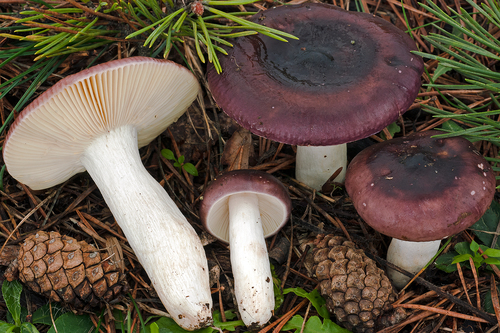
DescriptionThe cap is 3–10 cm (1–4 in) in diameter. It is dark purplish-brown, with a dark, sometimes almost black centre. When young, it is convex, or even nearly bell-shaped, but flattens as it matures. It nearly always retains a broad pointed boss (umbo) in the cap centre, a shape that is almost unique within the genus. The cap skin peels to two-thirds of the cap, and mature specimens have a furrowed margin. The firm, white stipe is 4–9 cm (1.5–3.5 in) high, 1–2 cm (0.5–1 in) wide and narrowly club-shaped. The gills are adnexed to almost free, pale ochre in colour, and produce a spore print of the same colour. They are quite closely spaced when young. The flesh is white and tastes mild, but the cap skin is bitter when tasted. Spores are ellipsoid and ornamented, measuring 8-9 μm × 6.5-8 μm. Distribution and habitatRussula caerulea appears in late summer and autumn. It is widespread in the northern temperate zones of Europe, Asia, and North America. It is probably mycorrhizal with pine trees (Pinus), growing on sandy soils.