About Russula brevipes Peck
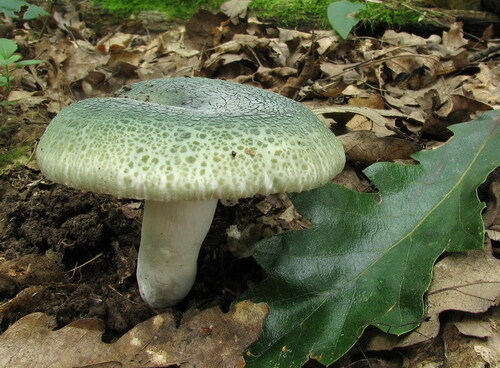
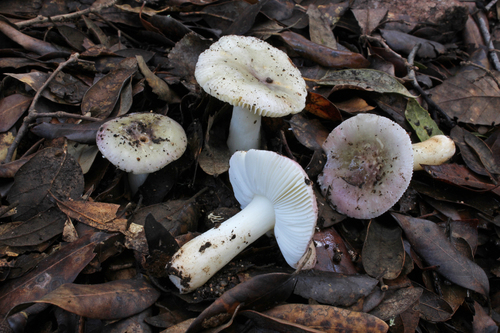
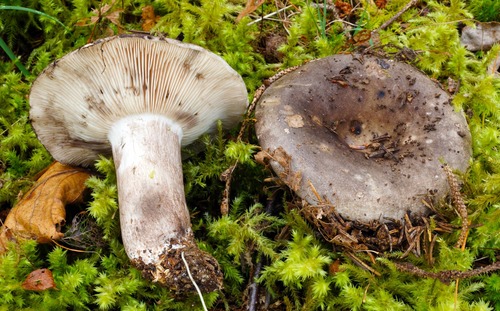
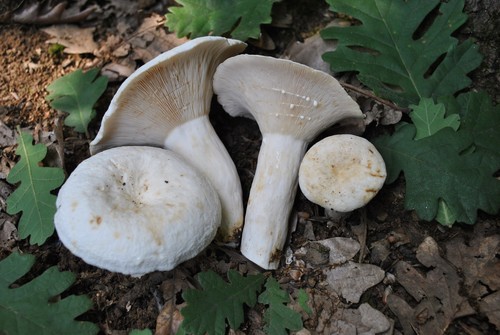
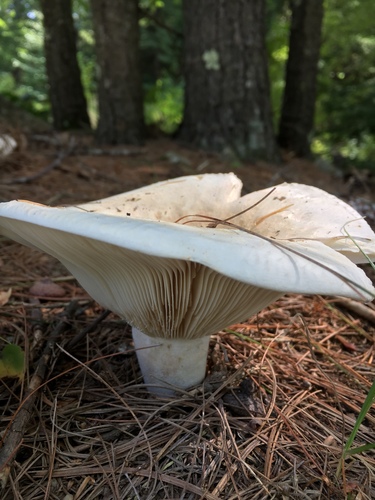
Fully mature Russula brevipes Peck caps have a diameter between 7 and 30 cm (3 to 12 inches). Caps are whitish to dull yellow, funnel-shaped with a depression at the center. Gills are narrow and thin, with decurrent attachment to the stem. They are nearly white when young, turning pale yellow to buff as they age, and are sometimes forked near the stipe. The stipe measures 3–8 cm long and 2.5–4 cm thick. It is white when young and develops yellowish-brown discolorations as it ages, and sometimes develops a pale green band around the top of the stipe. The spore print is white to light cream. The spores of R. brevipes are egg-shaped to roughly spherical, measuring 7.5–10 by 6.5–8.5 μm. Their surface is partially reticulate (network-patterned), dotted with warts up to 1 μm high. The cap cuticle forms a cutis, made of interwoven hyphae with rounded tips that run parallel to the cap surface. There are no cystidia on the cap (pileocystidia). Two variants of the species are recognized: R. brevipes var. acrior Shaffer has subtle green coloring on the stipe apex and gills, while R. brevipes var. megaspora produces larger spores that measure 9–14 by 8–12 μm. This is a common ectomycorrhizal fungus that forms associations with multiple tree hosts in temperate forest ecosystems. Typical host trees belong to the genera Abies, Picea, Pseudotsuga, and Tsuga. It has also been recorded growing with Pinus wallichiana in Himalayan moist temperate forests of Pakistan. Fruit bodies grow individually or in groups, with a fruiting season from summer to autumn. In eastern North America, fruiting occurs from July to October, while in western North America it takes place from October to January, with the highest abundance in late autumn. Mushrooms most often grow as "shrumps"—low, partially buried mounds on the forest floor—and are frequently partially eaten by mammals including rodents and deer. Research shows that geographically separated R. brevipes populations, whether across continents or globally, have significant genetic differentiation, indicating limited gene flow between these populations. By contrast, populations sampled from areas smaller than about 1,000 metres (3,300 feet) show little genetic differentiation. R. brevipes is one of several Russula species that forms an association with the myco-heterotrophic orchid Limodorum abortivum.