About Russula adusta (Pers.) Fr.
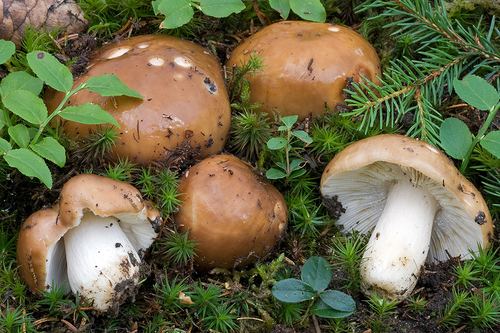
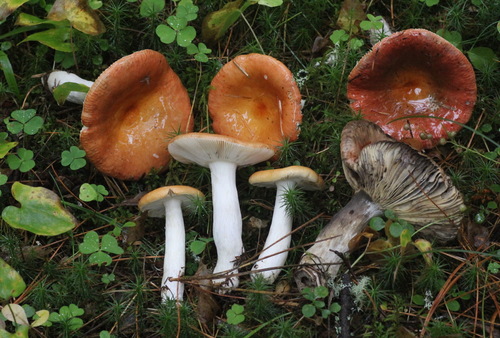
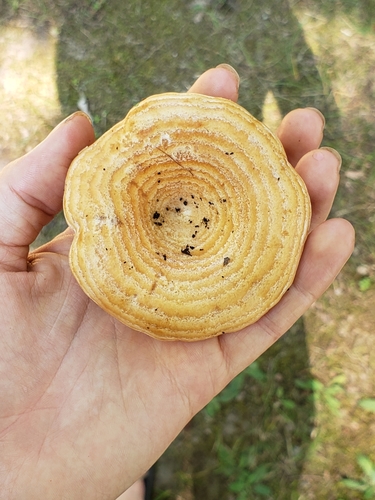
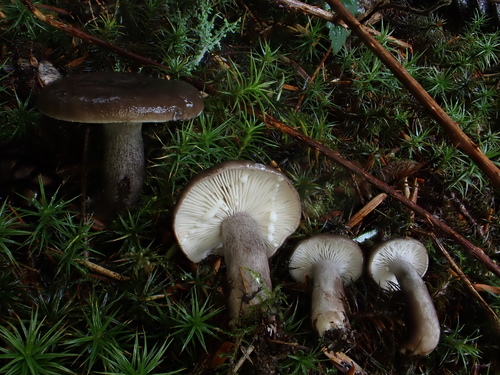
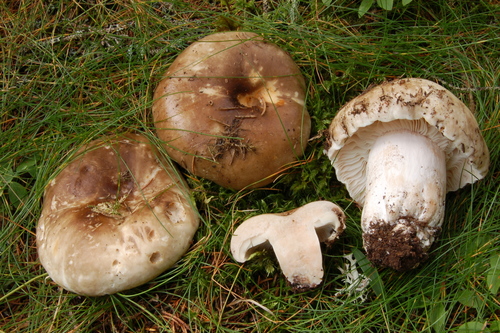
This species, Russula adusta (Pers.) Fr., is a large member of the genus Russula. Young caps are dirty white, and they quickly turn brown as they mature, eventually becoming black with age. Cap diameter ranges from 5–20 cm (2–8 in). Mature caps typically have a large depression in the centre, and three-quarters of the cap surface can be peeled away from the flesh. The stem is white, firm, and straight, measuring 5–8 cm (2–3 in) long and 2–5 cm (1–2 in) wide; it also turns black as it ages. Gills start off off-white, are very widely spaced, and attach to the stem (adnate). When bruised, gills turn red first, then grey, and finally black. The flesh has a fruity smell; when cut, it turns pale Indian red, then grey, and finally black within 20 minutes. The spore print is white, and the warty, oval spores measure 7–8 x 6–7 μm. Old specimens are sometimes parasitised by fungi of the genus Asterophora (also called Nyctalis), specifically N. parasitica and N. asterophora, commonly known as the pick-a-back toadstool.
Russula adusta grows in late summer and autumn in both deciduous and coniferous woodland, most often under conifer trees. It is distributed across Britain, northern Europe, and North America. In North America, it occurs in the Pacific Northwest and northern California from October to February.
This species contains toxins that can cause gastrointestinal upset. It is used for pickling, but requires parboiling before preparation.