About Rusavskia sorediata (Vain.) S.Y.Kondr. & Kärnefelt
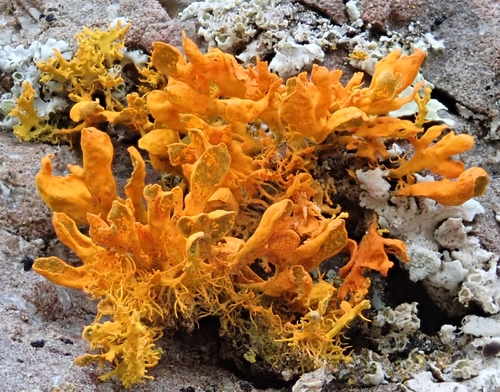
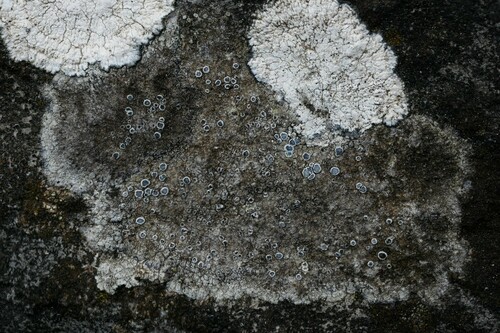
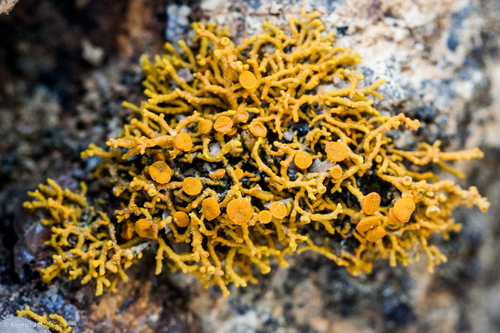
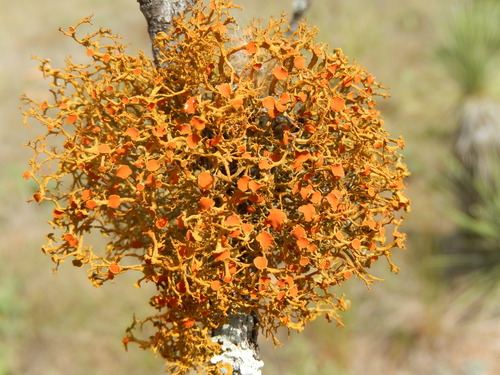
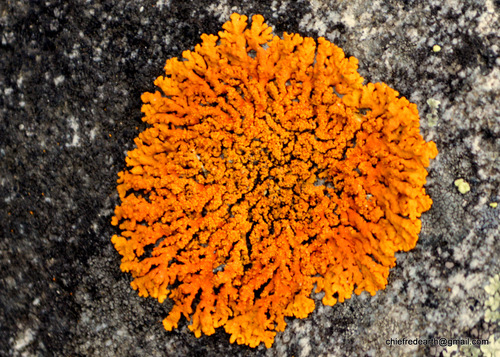
Rusavskia sorediata is a saxicolous, or rock-dwelling, crustose lichen belonging to the family Teloschistaceae. It is widely distributed across the Northern Hemisphere. Finnish lichenologist Edvard August Vainio first formally described this lichen in 1881, when it was classified as Lecanora elegans var. sorediata. Gustaf Einar Du Rietz transferred the species to the genus Caloplaca in 1916. Josef Poelt later determined the species fit better in the genus Xanthoria, and it was known by this binomial classification for several decades. In 2003, Sergey Kondratyuk and Ingvar Kärnefelt transferred the species to Rusavskia, a newly circumscribed genus they established. This lichen grows small, spherical pustules on its surface that eventually develop into granular soredia. The abundance of these soredia can vary, ranging from being barely noticeable to covering nearly the entire surface of the lichen's thallus. Due to the distinct appearance created by these granular propagules, the species has the common name sugared sunburst lichen in North America. Rusavskia sorediata has an Arctic-oreophytic distribution. "Oreophytic" describes organisms adapted to live in mountainous regions, specifically in areas growing above the forest line but below the permanent snow line. It has been documented in Asia, Europe, North America, and Greenland.