About Rumex venosus Pursh
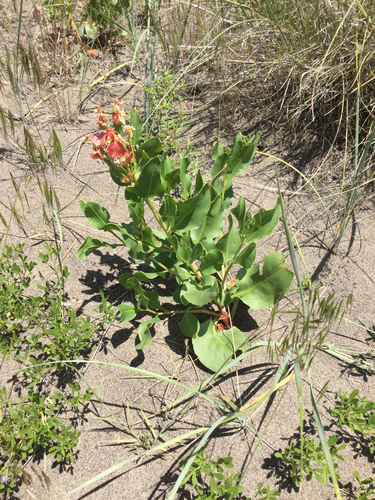
Rumex venosus Pursh is a perennial herb that grows from a creeping rhizome. It produces decumbent, spreading, or upright stems between 4 and 20 centimetres (1+1⁄2 to 8 inches) tall, and usually has a few branches. Its light green leaves are veiny, which gives the species its name. They are lance-shaped to oval, with smooth or wrinkled edges, and measure 2–15 cm (3⁄4–6 in) long and 1–5 cm (1⁄2–2 in) wide. Each leaf has a papery, sheath-like stipule above it. The inflorescence is a densely flowered panicle that grows either axillary or terminally. The flowers themselves are green and inconspicuous, not showy. They have 6 reddish sepals, 6 stamens, and 1 pistil. The bright pink colour associated with the plant’s flowers comes from the inner sepals of each flower as the fruit matures. As the fruit matures, the sepals enlarge to about 3 mm (1⁄8 in) long and 1.5 cm across, become quite veiny, and surround the achene. This plant flowers from mid-spring to mid-summer. Like all docks, Rumex venosus is considered edible, though its young leaves are often too sour to be palatable. Leaves and shoots stay tender through most of the growing season, making docks suitable as cooked vegetables, similar to beet shoots, but they usually require multiple boils to remove some of their bitter taste. The achenes can be boiled into a mush or ground into flour, but removing seeds from the chaff is considered too time-consuming to be worth the effort. Docks contain high levels of vitamin C and beta-carotene; Rumex crispus has higher levels of these nutrients than oranges and carrots have, respectively. The leaves of docks have been used to relieve the burning sensation from stinging nettle stings, and can be dried into a powder to help speed wound healing. Docks contain anthraquinones, which have laxative and antibacterial properties, and can stop the growth of some parasites and fungi. Mashed roots of docks have been used as a poultice. Boiling roots can also produce red, yellow, or black dye; Native Americans made orange dye from the roots.