About Rumex sagittatus Thunb.
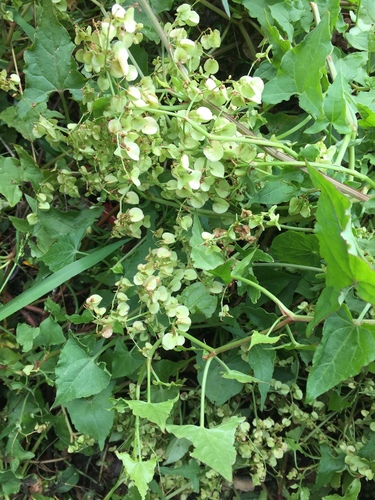
Rumex sagittatus Thunb. is a soft-stemmed, herbaceous scrambling and climbing plant. It has prominent triangular, arrow-shaped leaves that are 3–6 cm (1.2–2.4 in) long and 2–4 cm (0.8–1.6 in) wide. Its grooved green stem is sometimes distinctly tinted red. Small pinkish flowers grow on panicles that reach up to 15 cm (6 in) long. After flowering, the plant produces a 3-sided greenish pod 0.8–1 cm in diameter. This species grows from a tuber that can be up to 10 cm (4 in) long. It flowers and produces seed throughout summer, and may die back down to its tuber in colder regions. Rumex sagittatus is native to southern Africa, where it grows from Malawi and Zambia south to South Africa. It has become naturalized across many parts of Australia near urban areas, ranging from Queensland to eastern Tasmania, as well as in warmer areas of New Zealand. The plant spreads both by seed and by resprouting from its tuber. Its seeds float on water, so they can be carried long distances away from the parent plant. Tubers can be broken apart by tractors or road graders, and each broken fragment is capable of regrowing into a new plant; these fragments can also be difficult to locate when removing the plant by hand. Rumex sagittatus can grow over and smother other plants it covers. Its leaves and young stems can be cooked and eaten, and it is sometimes cultivated as a vegetable in Java.