About Rumex obtusifolius L.
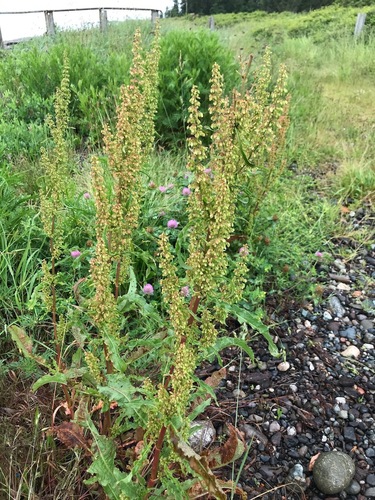
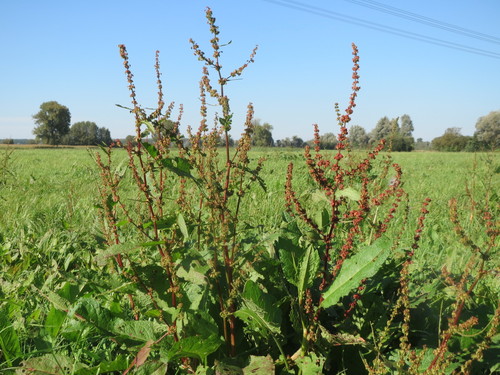
Rumex obtusifolius L. is a perennial herbaceous flowering plant that grows between 40 and 150 cm (16 to 59 in) tall. It is easily identified by its very large oval leaves with heart-shaped (cordate) bases and rounded tips; some lower leaves grow from red stems. Leaf edges are slightly crisped or wavy; the upper leaf surface is hairless, while the lower surface may have a papillose texture. Individual leaves can reach 30 cm (12 in) long and 15 cm (5.9 in) wide. This species has a large, branched taproot that extends as deep as 150 cm (59 in). Its stems are tough, often reddish, and stay unbranched until just below the inflorescence. Where leaf stalks (petioles) join the stem, they are covered by a thin, paper-like sheath called an ocrea, which is formed from two fused stipules; this structure is a defining characteristic of the Polygonaceae plant family. Stem leaves grow in an alternating arrangement and are narrowly ovate to lanceolate in shape. The plant's inflorescence is made up of large clusters of racemes, holding small greenish flowers that turn red as they mature. Its perianth segments are arranged in two whorls of three each. Outer whorl segments are small and spreading, while the inner whorl forms fruit valves that are broadly ovate-triangular. The plant produces dry, reddish-brown seeds, and blooms from June through September. Rumex crispus, commonly called curly dock, is similar in overall appearance, but it has thinner, more heavily wavy leaves. More specifically, curly dock has calyxes with smooth margins, while broad-leaved dock (Rumex obtusifolius) has calyxes with horned margins. Rumex obtusifolius is widely distributed across the globe. It grows readily in a wide range of habitats: arable land, meadows, waste ground, roadsides, ditches, shorelines, riverbanks, woodland margins, forest clearings, and orchards. Seedlings can be recognized by their oval leaves on red stems, and rolled leaves emerging from the center of the young plant. Regrowth from the plant's overwintering rosette typically occurs in spring. The leaves of Rumex obtusifolius can be eaten raw in salads, used to make vegetable broth, or cooked like spinach. They contain oxalic acid, which can be hazardous when consumed in large quantities. Dried seeds can be ground into flour. In Turkey, Romania and Greece, the leaves are sometimes used as a replacement for other plants when making sarmale. A tea made from the root was historically believed to cure boils. In Ireland and the United Kingdom, this plant often grows near stinging nettles, and it is a widely held folk belief that squeezing juice from the underside of a dock leaf and rubbing it on the skin relieves itching from nettle stings. This home remedy is not supported by any scientific evidence, though rubbing the area may work as distracting counterstimulation, and belief in the remedy may produce a placebo effect.