About Rumex crispus L.
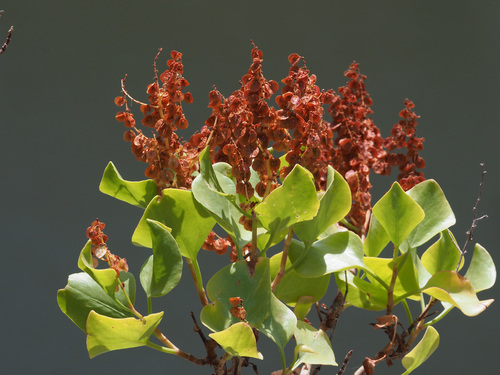
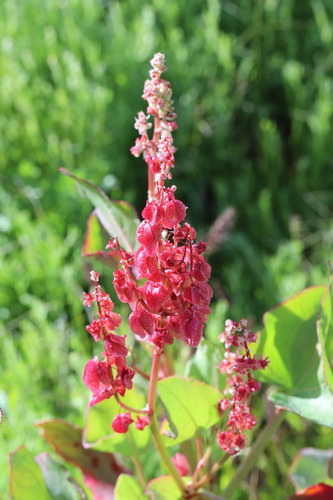
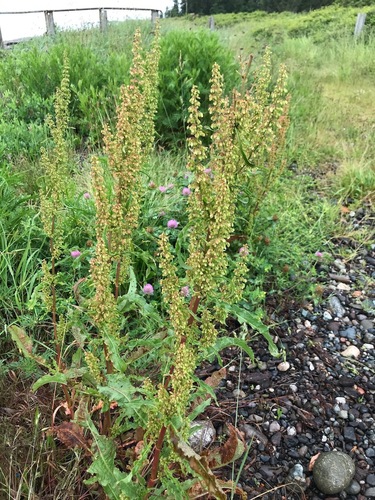
Rumex crispus L., commonly called curly dock or yellow dock, produces a flower stalk that reaches up to 1.5 meters (5 feet) tall. Its smooth leaves emerge from a large basal rosette, and have distinct waved or curled edges; these leaves grow between 14 and 24 centimeters (5 1/2 to 9 1/2 inches) in length. Flowers and seeds develop in clusters on branched stems along the stalk, with the largest cluster located at the apex of the stalk. The seeds are shiny brown, and remain enclosed in the calyx of the flower that produced them. This outer casing allows the seeds to float on water and catch onto wool and animal fur, which helps the seeds disperse to new locations. Curly dock has a large, yellow, forked taproot. Several subspecies of Rumex crispus exist, each with distinct habitat preferences: R. crispus ssp. crispus grows on waste and cultivated ground; R. crispus ssp. littoreus has a coastal distribution; and R. crispus ssp. uliginosus grows on tidal estuarine mud. This species readily hybridizes with other Rumex species, including Rumex obtusifolius, Rumex obovatus, Rumex palustris, and Rumex maritimus. It is native throughout temperate Eurasia, and is widespread as an introduced species in North America and other temperate regions. Curly dock grows in a wide range of habitats, including disturbed soil, waste areas, roadsides, fields and meadows, shorelines, and forest edges. It is widely naturalized across the temperate world, and has become a serious invasive species in many areas, including all of North America, southern South America, New Zealand, and parts of Australia. It spreads via seeds that contaminate crop seeds and stick to clothing. It is classified as an "injurious weed" under the UK Weeds Act 1959, and is classified as a noxious weed in the U.S. states of Arkansas and Iowa. It is often found in disturbed soils along the edges of roadsides, railway beds, and car parks. Curly dock can be eaten as a wild leaf vegetable. Young leaves should be boiled in multiple changes of water to remove as much oxalic acid as possible, or can be added directly to salads in small to moderate amounts. Mature leaves become too bitter to consume. Dock leaves are an excellent source of vitamin A and vitamin C, and also provide iron and potassium. Curly dock leaves have a tart flavor from high oxalic acid levels. While they are quite palatable, the plant should only be consumed in moderation, because it can irritate the urinary tract and increase the risk of developing kidney stones. It should be used carefully during lactation, as it may cause a laxative effect in infants. In Armenia, young curly dock plants are harvested and dried to create a product called Aveluk (ավելուկ). Fermentation occurs during drying to reduce bitterness, and the dried plants are braided into rings for sale. Aveluk is widely used in Armenian cooking as a base for salads and soups, after being reconstituted by boiling in water. Thoroughly dried curly dock seeds are also edible. The dark brown to black seed pods remain on the stalk until spring, when new leaves begin to grow. Unlike most wild foraged grains, which require winnowing to remove pods, the small pods of Rumex crispus are more efficiently ground along with the seed. The resulting flour has a flavor similar to buckwheat. While some people find this flour too bitter, many prefer the flavor of the seeds over the tartness of the leaves. In Western herbalism, the root is often used to treat anemia, because it contains high levels of iron. It can be powdered and put into capsules, frequently combined with stinging nettle (Urtica dioica), which is a classic herbal pairing with curly dock. Both leaves and root can have a mild laxative effect in some people (though not all), caused by the presence of anthroquinone glycosides. This effect is not consistent enough to rely on, and should be considered a possible side effect when consuming the plant. The plant may also cause intestinal discomfort in some people. Taken internally or applied externally, it is said to help with skin conditions such as itching, scrofula, and sores. Some studies indicate that certain anthroquinones can stop or slow cancer growth, but it is unclear if this applies to the anthroquinones found in yellow dock. Yellow dock is included in the homeopathic pharmacopoeia. It is used mainly for respiratory conditions, specifically tickling cough that worsens when exposed to cold air. It is also used for passing pains, excessive itching, and enlarged lymph nodes. The Zuni people apply a poultice of powdered root to sores, rashes, and skin infections, and use an infusion of the root to treat athlete's foot.