About Rumex acetosella L.
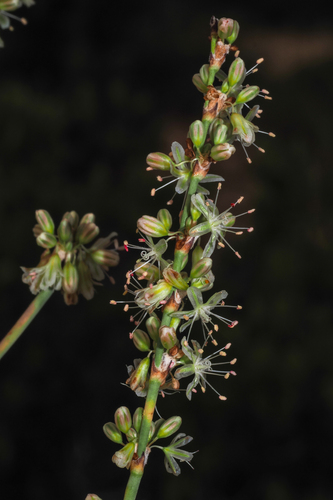
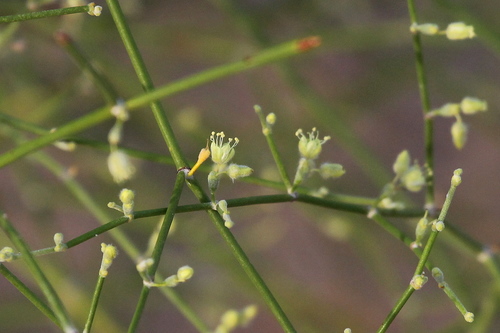
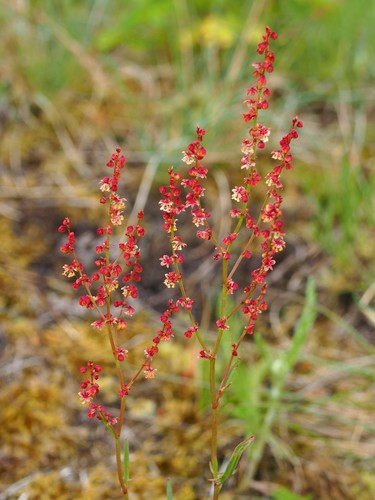
Rumex acetosella L. is a perennial herb that spreads through rhizomes. It produces a slender, reddish upright stem that branches at the top, and grows up to 50 centimeters (20 inches) in height. Its small arrow-shaped leaves measure roughly 2.4–5 cm (1–2 in) long and 0.5–2 cm (1⁄4–3⁄4 in) wide, and have pointed lobes at their base. This plant blooms from March to November; yellowish-green male flowers and reddish female flowers grow on separate individual plants at the tip of the stem, and these flowers later develop into red achenes (fruits). It should not be confused with the similarly named R. acerosella, which also contains oxalic acid and should not be eaten in large quantities. Rumex acetosella is native to Eurasia and the British Isles, and has been introduced to most other parts of the Northern Hemisphere. It commonly grows in acidic, sandy soils in heaths and grassland, and is often one of the first species to colonize disturbed areas such as abandoned mining sites, particularly when the soil is acidic. As a dioecious species, Rumex acetosella has separate male and female plants. Research has found that relatively more female plants grow in early successional habitats, while male plants are more common in later successional stages. It has been recorded as an invasive species in Sphagnum peatlands disturbed by peat extraction in southern Patagonia. Livestock will graze on this plant, but it is not very nutritious and is toxic in large amounts due to its oxalate content. Italian agronomist Nicola Onorati (1764–1822) first discovered that the oxalic acid in the plant damages the teeth of animals that graze on it. Ground-feeding songbirds eat its seeds, and larger animals such as rabbits and deer browse its leafy greens. The American copper (small copper) butterfly relies on Rumex acetosella as a food source, though the butterfly’s larvae can also eat some related plants. Rumex acetosella is widely considered a hard-to-control noxious weed because of its spreading rhizomes. Blueberry farmers commonly encounter this weed, as it thrives in the same growing conditions that blueberries require. The plant contains oxalic acid and its derivatives, known collectively as oxalates. Its leaves can be eaten raw or cooked; changing the cooking water reduces the plant’s strong taste. The oxalic acid in the leaves gives them a somewhat sour flavor. The leaves have a lemony, tangy or rhubarb-like tart taste, and have several food uses: they can be used as a garnish, a tart flavoring agent, a salad green, and as a curdling agent for milk in cheese-making.