About Rudbeckia laciniata L.
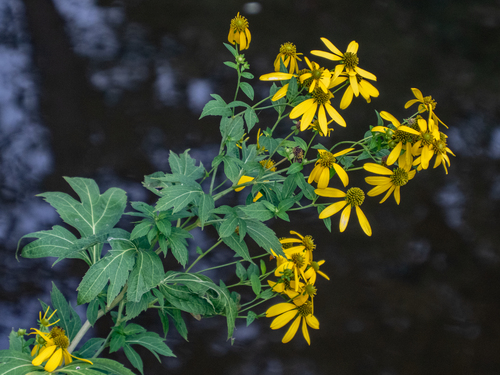
Rudbeckia laciniata L. is a robust herbaceous perennial plant that grows up to 2 metres (6+1⁄2 feet) tall. It forms long rhizomes that act as persistence organs, paired with fibrous roots. Its stem is bare. The alternate leaves are usually split into a petiole and a leaf blade, reaching up to 20 cm (7+3⁄4 in) in length. The leaves are broadly ovate, somewhat glaucous, often deeply dissected, and have smooth to roughly serrated margins. Leaf blades can be smooth or hairy, and are either simple or one to two-pinnate; leaflets are lobed three to eleven times.
This species is native to North America, where it is widespread across both Canada and the United States. Its natural habitat consists of wet sites, including floodplains, stream banks, and moist forests.
Rudbeckia laciniata is somewhat toxic to livestock. There is one report of circumstantial evidence of poisoning in horses, sheep, and pigs.
This species is widely cultivated in gardens and for use as cut flowers. Numerous cultivars have been developed; two of these, 'Herbstsonne' (meaning "Autumn sun") and 'Starcadia Razzle Dazzle', have earned the Royal Horticultural Society's Award of Garden Merit. The cultivar 'Goldquelle' produces double yellow, pom-pom blooms that measure 8 cm across. Rudbeckia laciniata has long been grown as an ornamental plant. It was brought to Paris and planted in the private garden of Vespasian Robin at the start of the 17th century. In 1622, Caspar Bauhin received this ornamental plant from Robin, and described it as 'Doronicum americanum laciniato folio'. The earliest recorded garden cultivation of this plant in Germany dates to 1646 in Altdorf. The double-flowered form, which is the most commonly grown today, has been known since around 1894. The first recorded naturalization of this species on river banks in Central Europe was observed in the 18th century. Anton Johann Krocker documented its presence in 1787 in Queistal near Flinsburg in eastern Upper Lusatia. As an ornamental plant, varieties (including double-flowered forms) are used in parks and gardens across temperate regions. In Europe, Rudbeckia laciniata has become an established wild species in multiple countries. Outside of Europe, it is a neophyte in China and New Zealand. The Lady Bird Johnson Wildflower Center notes that because cut-leaf coneflower spreads rampantly via underground stems, it is only suitable for large sites.
Traditionally, young leaves of Rudbeckia laciniata are collected from the wild and eaten in early spring. They are very popular as a cooked potherb. While some sources recommend using this plant as raw salad greens, traditional use always involves cooking the leaves. This cooking is generally assumed to remove toxins, though there is little evidence that such toxins are present.