About Rudbeckia hirta L.
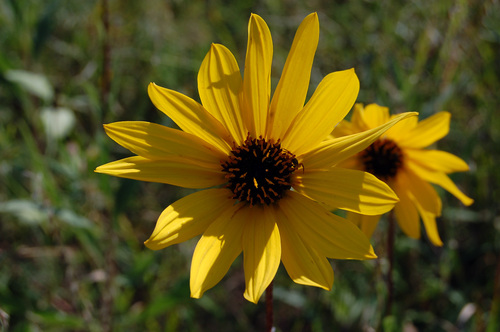
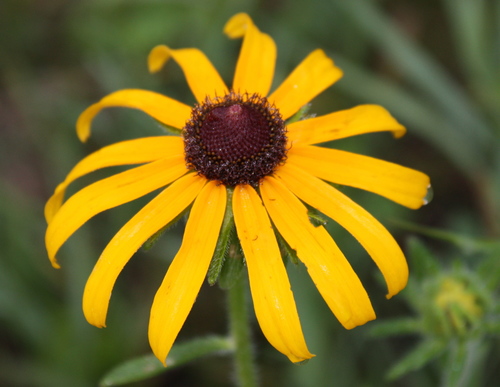
Rudbeckia hirta L. is an upright annual plant, sometimes biennial or perennial. It grows 30–100 cm (12–39 in) tall by 30–45 cm (12–18 in) wide. It has alternate, mostly basal leaves 10–18 cm long, covered by coarse hair, with stout branching stems and daisy-like, composite flower heads that appear in late summer and early autumn. In the wild species, flowers reach up to 10 cm (4 in) in diameter, with yellow ray florets circling a prominent brown or black, dome-shaped cone of many small disc florets. Extensive breeding has produced a range of sizes and colours, including oranges, reds and browns. It is native to eastern and central North America, and is naturalized in the west, found in all 10 Canadian Provinces and all 48 contiguous United States. It is also naturalized in China. Butterflies are attracted to Rudbeckia hirta. It is a larval host to the bordered patch, gorgone checkerspot, and silvery checkerspot butterfly species. Dragonflies, which eat many mosquitoes, are attracted by the tiny pollinators of these flowers. The species is toxic to cats when ingested. Rudbeckia hirta is widely cultivated in parks and gardens for summer bedding schemes, borders, containers, wildflower gardens, prairie-style plantings, and cut flowers. Numerous cultivars have been developed, of which 'Indian Summer' and 'Toto' have gained the Royal Horticultural Society's Award of Garden Merit. Other popular cultivars include 'Double Gold' and 'Marmalade'. Gloriosa daisies are tetraploid R. hirta cultivars with much larger flower heads than the wild species, often doubled or with contrasting markings on the ray florets. They were first bred by Alfred Blakeslee of Smith College by applying colchicine to R. hirta seeds; Blakeslee's stock was further developed by W. Atlee Burpee and introduced to commerce at the 1957 Philadelphia Flower Show. Gloriosa daisies are generally treated as annuals or short-lived perennials and are typically grown from seed, though some named cultivars exist. The plant is recorded as a Native American medicine for various ailments. The roots, though not the seedheads, can be used much like the related Echinacea purpurea, with unsubstantiated claims to boost immunity and fight colds, flu and infections. The Ojibwa people used it as a poultice for snake bites and to make an infusion for treating colds and worms in children.