About Rudbeckia fulgida Aiton
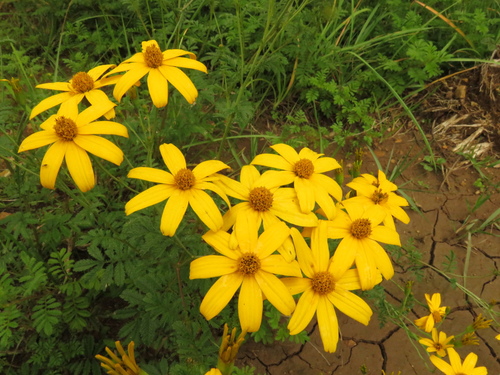
Rudbeckia fulgida Aiton is an herbaceous perennial plant that can grow up to 120 cm (47 in) tall, producing bright yellow, daisy-like composite flower heads. Its stems are dark green, hairy, and ridged, and may be smooth or moderately hairy with spreading branches. Leaves are dark green, unlobed, simple, and have sparsely serrated to sometimes lacerated margins. Leaf blades range in shape from lanceolate to broadly ovate or elliptic, with bases ranging from attenuate to cordate. Upper leaf surfaces are either smooth or covered in fine to coarse hairs. Basal leaves are stalked, with petioles 5–30 cm (2–12 in) long and 1–8 cm (0.4–3.1 in) wide. Stem (cauline) leaves have shorter, narrower petioles 2–25 cm (0.8–9.8 in) long and 0.5–7 cm (0.2–2.8 in) wide, with bases that can be attenuate, cordate, or auriculate.
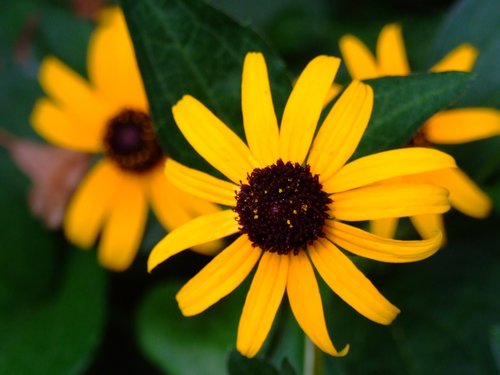
Flower heads are typically borne one per stem, but may also grow in corymb-shaped clusters of 2 to 7 flowers per stem, held on stems that extend above the main foliage. Each flower head has black disc florets and bright orange ray florets. The receptacle (the cup-like structure holding the flowers) is hemispheric to ovoid, with paleae 2.5–4 mm (0.10–0.16 in) long that have blunt to pointed tips, usually smooth at the end with ciliate apical margins. There are 10 to 15 ray florets per head, with elliptic to oblanceolate laminae 15–25 cm (5.9–9.8 in) long and 3–6 mm (0.12–0.24 in) wide; the lower surface of the laminae bears fine strigose hairs. The central flower disc is 12–16 mm (0.47–0.63 in) tall and 10–18 mm (0.39–0.71 in) wide, made up of between 50 and over 500 disc florets. Each disc floret corolla is yellowish green near the base and brown-purple toward the tip, is 3–4.2 mm (0.12–0.17 in) long, and has style branches 1.3 mm (0.05 in) long.
This species can be found in a range of habitats including bogs, woodlands, bottomlands, and calcareous slopes. It spreads both via stoloniferous stems and by seed. Seeds are produced in dry fruits called cypselae, which are 2.2 to 4 mm (0.09 to 0.16 in) long with short coroniform pappi 0.2 mm (0.008 in) long. Ripe seeds are a favored winter food source for finches. Flowering has been recorded from January through September.
There are seven recognized varieties of Rudbeckia fulgida: Rudbeckia fulgida var. deamii (S. F. Blake) Perdue (Deam's coneflower), Rudbeckia fulgida var. fulgida Aiton (orange coneflower), Rudbeckia fulgida var. palustris (Eggert ex C.L. Boynt. & Beadle) Perdue (orange coneflower, prairie coneflower), Rudbeckia fulgida var. spathulata (Michx.) Perdue (orange coneflower), Rudbeckia fulgida var. speciosa (Wender.) Perdue (orange coneflower), Rudbeckia fulgida var. sullivantii (C.L. Boynt. & Beadle) Cronquist (Sullivant's coneflower), and Rudbeckia fulgida var. umbrosa (C.L. Boynt. & Beadle) Cronquist (orange coneflower). Both Rudbeckia fulgida var. deamii and the cultivar Rudbeckia fulgida var. sullivantii 'Goldsturm' have received the Royal Horticultural Society's Award of Garden Merit. Vernalization (cold treatment) helps encourage flower initiation, with the following recommended treatment durations and temperatures: 'Goldsturm' requires 10–12 weeks at 40 °F (4 °C); 'Little Goldstar' requires 10 weeks below 40 °F (4 °C); 'Pot of Gold' requires 10 weeks at 35–41 °F (2–5 °C).