About Rubus ursinus Cham. & Schltdl.
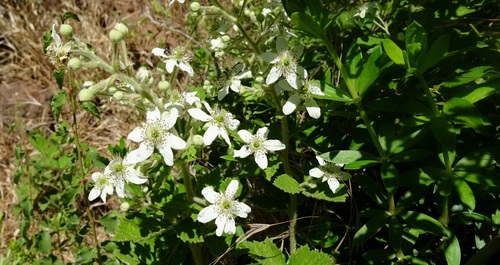
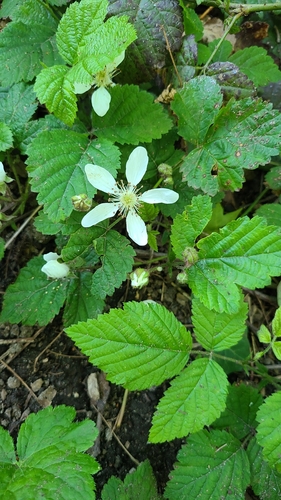
Rubus ursinus Cham. & Schltdl. is a wide, mounding shrub or vine that grows 0.61–1.52 metres (2–5 feet) high and reaches over 1.8 m (6 ft) wide. Its prickly branches can root when they touch soil, allowing the plant to spread vegetatively and form large clonal colonies. Its deciduous leaves most often have 3 leaflets, but may sometimes have 5 or just 1. This species is dioecious, meaning male and female flowers grow on separate individuals, an unusual trait for the Rubus genus. Like other Rubus, its canes grow vegetatively during their first year and become reproductive during their second year. The flowers are white, fragrant, and have narrower petals than most related species. The fruits are sweet, highly aromatic, range in color from dark purple and dark red to black, and grow up to 2 centimetres (3⁄4 inch) in length. This plant is native to western North America, occurring mainly in British Columbia, Canada; the western U.S. states of California, Idaho, Montana, Oregon, and Washington; and Baja California, Mexico. A wide range of wildlife consumes its berries, including songbirds, deer, bear, and other small and large mammals. It provides notable value for native bees and bumblebees as a source of pollinator resources and nesting material. This blackberry species acts as a larval food source for four butterfly species: Papilio rutulus (western tiger swallowtail), Nymphalis antiopa (mourning cloak), Strymon melinus (gray hairstreak), and Celastrina ladon (spring azure). Rubus ursinus is cultivated both for its edible fruit and for its ornamental qualities. It is planted in home gardens, native plant gardens, wildlife gardens, and natural landscaping projects. It can be espaliered or trained to grow along fences and trellises. Mature, established plants are effective at stabilizing creek banks and bioswale edges. To produce large fruit, the plant requires consistent moisture, but established specimens are moderately drought tolerant without this consistent moisture. Seed size appears to correlate with fruit "cell" size, and the smallest fully formed berries (around 1 cm or 3⁄8 inch) are the most highly prized. These small berries are sometimes called "little wild blackberries". Multiple Native American groups, including the Kumeyaay, Maidu, Pomo, Interior Salish, and Coast Salish peoples, have used R. ursinus as a source of fresh and dried fruit and as a traditional medicinal plant. The Concow tribe calls this species Gol-lē' in the Konkow language.