About Rubus swinhoei Hance
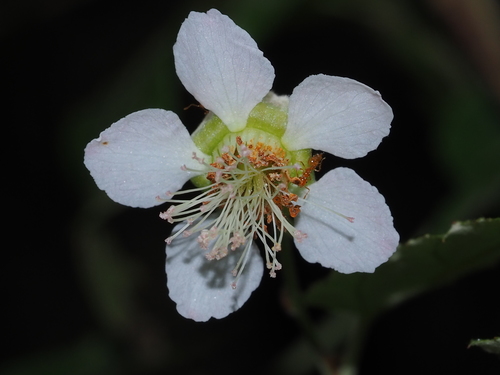
This species is a semi-evergreen shrub that grows 1 to 4 meters (3 feet 3 inches to 13 feet 1 inch) tall. Young stems are dark purple-brown and covered in gray-white pubescence, while older stems become glabrous. It produces single leaves that vary greatly in shape, ranging from lanceolate to broadly ovate. Leaves measure 5 to 11 cm (2.0 to 4.3 in) long and 2.5 to 5 cm (0.98 to 1.97 in) wide, with a pointed tip and a shallow cordiform base. Soft hairs grow along the leaf veins; the lower leaf surface is either tomentose or subglabrous, and the upper (adaxial) leaf surface is tomentose. The leaf margin is ciliate or glabrous, serrated, and bears 0 to 12 pairs of leaf veins. The petiole is 0.5 to 1.5 cm (0.20 to 0.59 in) long, covered in purple-brown glandular hairs, with sparse spines and tomentum. Flowers grow in clusters of 5 to 6. Flower stalks and sepals are 0.1 to 0.3 cm (0.039 to 0.118 in) long and have purple-brown glandular hairs. Open flowers are 1 to 1.5 cm (0.39 to 0.59 in) in diameter, with a slender flower stalk that measures 1 to 3 cm in length. Hairy, serrated flower buds produce ovate or triangular sepals that are 0.5 to 0.8 cm (0.20 to 0.31 in) long. Sepals are covered in gray-white hair, have a pointed apex and entire margins, and become reflexed during fruiting. Petals are white, ovate or nearly round, and covered in fine hoary hair. Most stamens have glabrous, swollen filament bases. Pistils are longer than stamens, and the ovary is glabrous. The flowering period runs from May to June. The fruit is spherical, 1 to 1.5 cm (0.39 to 0.59 in) in diameter, made up of glabrous drupes. Ripe fruit changes color from red-green-purple to black-purple. The fruit core has a wrinkled texture and a sour taste. The fruiting period runs from July to August. Rubus swinhoei is native to central and southern China, and Taiwan. In northern and central Taiwan, it grows in plains, foothills, and mountains at elevations ranging from 10 to 900 m (33 to 2,953 ft).