About Rubus spectabilis Pursh
Rubus spectabilis Pursh, commonly called salmonberry, is a deciduous, rhizomatous shrub with a moderate growth rate of 0.3–0.6 m (12–24 inches) per year. It reaches 1–4 metres (3.3–13.1 feet) tall and up to 9 m (30 ft) wide, with 30–40% of its total biomass located underground. It produces perennial woody stems (called canes) that are golden to yellowish brown, either erect or arching, and covered in fine prickles, particularly on new growth. Like other brambles in the genus Rubus, these canes often grow together to form thickets.
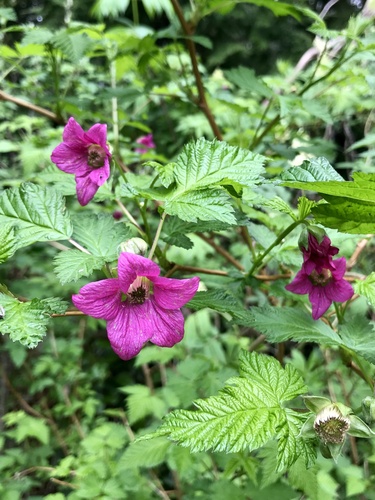
The leaves are alternate, trifoliate (made of three leaflets), and 7–22 centimetres (3–8+1⁄2 in) long overall. Leaflets are typically ovate, with the terminal leaflet larger than the two side leaflets, which are sometimes shallowly lobed. Leaflet margins are doubly serrate. The leaves are stipulate; they are smooth to slightly hairy on the upper surface, while the underside is typically paler and more hairy. Salmonberry drops its leaves in late fall and winter, and remains dormant or shows only minimal shoot elongation over the winter months.
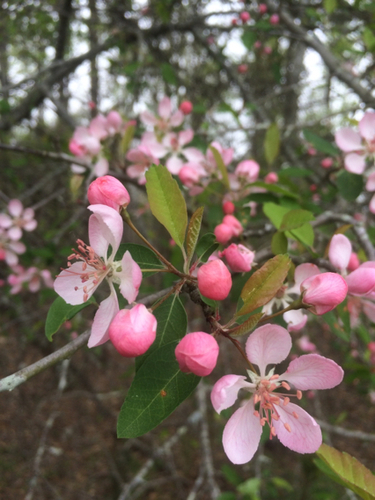
Flowers are 2–3 cm (3⁄4–1+1⁄4 in) in diameter, with a calyx of five hairy sepals and five pinkish-purple petals surrounding a cluster of stamens. They appear between April and July, growing either singly or in clusters of 2 or 3. The flowers are perfect (bisexual), holding 75–100 stamens and many individual pistils with superior ovaries. This species cannot self-pollinate; pollination is done by insects, hummingbirds, and beetles.
Fruit production is mostly dependent on environmental conditions, with an estimated average of 30 fruits per 3 square metres (32 sq ft) and 17–65 seeds per fruit. Salmonberry primarily sprouts from buds on its rhizomes, stumps, and root crowns. Fruits ripen 30–36 days after pollination: from early May to late July across most of the Pacific Northwest, and from July to August in cooler Northern climates. Ripe fruits are 1.5–2 cm (1⁄2–3⁄4 in) long, and resemble large shiny raspberries that range in color from yellow to dark red. Unlike blackberries, the salmonberry fruit pulls cleanly away from its receptacle. Botanically, it is not a true berry, but an aggregate fruit made of many small drupelets.
Salmonberry fruit exhibits color polymorphism, with individual plants producing either red berries or yellow-orange berries. Research has found that while red and yellow-orange morphs have similar physical traits, red berries are more commonly consumed by birds. This selection pressure is likely not strong enough to determine the distribution of color morphs on its own; factors such as soil type (which affects germination), along with other unstudied factors, are more likely responsible for this color polymorphism.
Salmonberry is most commonly found in coastal areas with nitrogen-rich soils, growing in moist to wet forests and along streambanks. It becomes more abundant in regions with high rainfall, and less abundant at higher elevations and in more continental inland climates. Ecologically, it tends to spread quickly and requires plenty of space to grow. It is often a dominant, fast-growing species in early-seral communities. Its size and population abundance decline as the forest canopy develops, and growth can also be influenced by factors including basal area, plant disturbance, and population density. In open areas, it often forms large thickets, and is commonly associated with stands of red alder (Alnus rubra), lady fern (Athyrium filixfemina), western skunk cabbage (Lysichiton americanus), devil's club (Oplopanax horridus), thimbleberry (Rubus parviflorus), and threeleaf foamflower (Tiarella trifoliata).
In the wild, salmonberry fruit is eaten by birds, bears, small mammals, and other animals, while the leaves, twigs, and stems are grazed by herbivores including deer, moose, mountain goats, elk, and rabbits. Dense thickets provide escape habitat for small animals and nesting sites for birds. Spring flowering of salmonberry coincides with the migration of certain hummingbird species, which is critical for its pollination. Birds and mammals disperse salmonberry seeds through their feces, while burrowing animals like rodents can further assist with dispersal. Grizzly bears and American black bears are especially important seed dispersers: a single fecal pile from one of these bears can deposit 50,000 to 100,000 salmonberry seeds.
Salmonberry has multiple traits that make it highly resistant to fire. Rhizomes and root crowns below the soil surface usually survive fire even when the above-ground stems are burned, and seeds often remain unharmed depending on their burial depth. The plant also sprouts very quickly after fires, allowing for rapid growth and regeneration.
This species is susceptible to many diseases, including mildew, fruit rot, rust, root rot, and both viral and bacterial diseases. Its fruits, foliage, canes, roots, and crowns can be damaged by pests including beetles, aphids, mites, moths, and other insects.
Salmonberry is an edible plant. The flavor of its fruit is reported to vary widely, ranging from bright, fruity, and citrusy to deep and earthy with spicy notes. Depending on ripeness and growing site, both red and golden fruits are good eaten raw, and can also be processed into jam, candy, jelly, and wine. Native American peoples have long eaten the young shoots and used the plant as a medicinal plant. Shoots are harvested from April to early June before they become woody or tough; they are peeled, then steamed, boiled, or pit-cooked before eating, and are rarely eaten raw. Traditionally, both berries and shoots were eaten with salmon, or mixed with oolichan grease or salmon roe. They were not dried due to their high moisture content. Salmonberry is still used as a food and medicinal plant in parts of Alaska today.
Additional traditional uses by Native American peoples include: boiling leaves with fish to add flavor by the Nuu-chah-nulth people; using leaves to line baskets, wipe fish, and cover cooking pits by the Kaigani Haida people; using branches as pipe stems by the Makah people; chewing and spitting leaves (or bark in winter) onto burns as an astringent treatment by the Quileute people; and boiling bark in seawater to make a brew for cleaning infected wounds (especially burns) and reducing labor pains by the Quinault people.
It is also widely grown as an ornamental plant valued for its flowers, and a double-flowered clone has been identified in Washington and British Columbia. R. spectabilis has escaped cultivation and become naturalized in parts of northwestern Europe, including Great Britain, Ireland, and the Faroe Islands.